
If you live in Ruskin, Apollo Beach, Riverview, Wimauma, Sun City Center, Brandon, Gibsonton, or Valrico, you already know something is wrong with the water.
Pressure problems. Boil water notices. Restrictions on outdoor irrigation during dry stretches. A system that strains visibly during peak demand. A water infrastructure serving one of the fastest-growing corridors in Florida that was designed for a South County that no longer exists — and that has been stretched, patched, and apologized for while the commission kept approving more units.
Hillsborough County’s answer to this is the One Water Program: a $1.6 billion investment in drinking water, wastewater, and reclaimed water infrastructure for the South-Central Service Area. It is, by any measure, the most significant water infrastructure program in the county’s history. And it is necessary — genuinely, urgently necessary — for the people who have been living on a water system that was never adequate for the growth their elected commissioners approved.
That is the part of the story that does not appear in the press releases.
What the One Water Program Is
The One Water Program represents a philosophical shift in how Hillsborough County thinks about water. Traditionally, water management has operated in silos: drinking water over here, wastewater over there, stormwater somewhere else, reclaimed water as an afterthought. The One Water framework — embedded in the county’s Comprehensive Plan and now being built out in physical infrastructure — treats all of these as part of a single continuous cycle.
The concept, as the county’s planning commission put it, recognizes that water at every stage and in every form has value: stormwater that was once considered a nuisance to be shed as quickly as possible becomes a resource that can recharge the aquifer, sustain wetlands, or support habitat. Wastewater treated to advanced standards becomes reclaimed water. Reclaimed water injected into the aquifer becomes a barrier against saltwater intrusion. The county is already demonstrating this at the South Hillsborough Aquifer Recharge Project near Apollo Beach and Ruskin, where reclaimed water pumped into injection wells has halted saltwater intrusion and stabilized aquifer levels in the coastal zone.
The program’s infrastructure components are substantial:
The centerpiece is the One Water Campus Advanced Wastewater Treatment Facility — a 200-acre site off County Road 672 (Balm-Picnic Road) near Lithia, not far from the Southeast County Landfill. At $671 million, it is designed to meet the South-Central Service Area’s wastewater needs through 2050, with capacity for expansion beyond that. It will produce reclaimed water for reuse throughout the region.
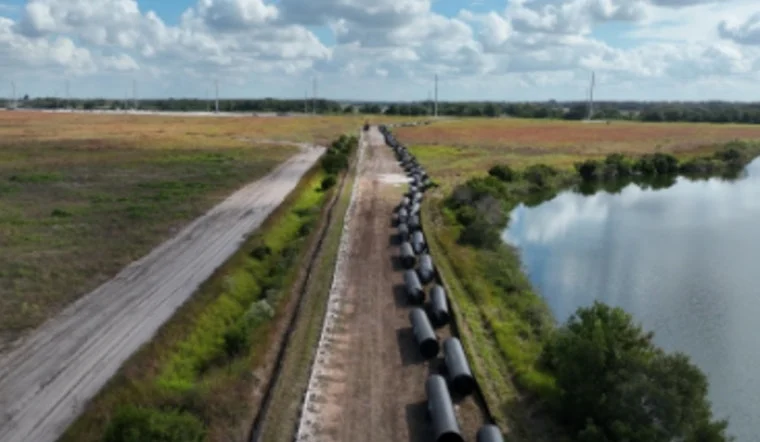
Moving wastewater to that facility requires the Balm Road Super Pump Station, designed to convey up to 56 million gallons of wastewater per day, and a network of large-diameter force main pipelines routing from a connection point near U.S. Highway 301 through some of the most actively growing communities in the county.
On the drinking water side, the program includes a completed $100 million South County Potable Water Transmission Main — more than 24,000 feet of 42-inch pipe and nearly 30,000 feet of 48-inch pipe installed between 2022 and late 2024 — along with new booster pump stations, expanded storage tanks, and connection points designed to improve pressure and redundancy across the service area.
Running parallel to the county’s program is Tampa Bay Water’s own $505 million, 26.5-mile South Hillsborough Pipeline, now under construction, which will deliver up to 65 million gallons of fresh drinking water per day from Tampa Bay Water’s regional facility in Brandon to the Lithia Water Treatment Plant and a new Balm connection point. When finished — currently projected for late 2028 — the pipeline will be the backbone of the regional water supply for District 1.
Together, these projects represent the most significant infrastructure commitment the county and its regional water authority have ever made to south and central Hillsborough County.
What Is Not In the Brochure
Here is what the county’s press materials do not say, and what every resident of the South-Central Service Area needs to understand.
The One Water Program is not a visionary decision to get ahead of growth. It is a catch-up effort required by decades of decisions to approve growth without ensuring the infrastructure to support it.
The county’s own planning documents acknowledge that water demand in the South-Central Service Area has dramatically outpaced projections — and that the gap is driven by development. By 2045, population modeling projects that the number of homes in the Boyette area will increase by roughly a third, Wimauma will more than double, and the combined Wimauma and Balm area will nearly triple. That growth did not happen by accident. It happened because the commission approved the permits.
As one south county civic leader said at a public meeting on the pipeline project: for years, county officials “allowed too many building permits to be approved in south county without having proper infrastructure in place, and now all these people in the line of this pipeline are going to have to be inconvenienced.” That inconvenience will run for the better part of five to six years. The pipeline alone will require tunneling under State Road 60, under major commercial corridors, past Kingswood Elementary and Brandon High School, and under the Alafia River. Streets affected include Woodberry Road, Victoria Street, and South Kings Avenue in Brandon; FishHawk Boulevard in Lithia; and Boyette Road and Balm Boyette Road in Riverview and Balm. Temporary lane closures, detours, reduced speeds, and construction disruption will be the daily reality for communities that already deal with some of the worst traffic in the county.
The program is also inseparable from the county’s decision to expand the Urban Service Area — the boundary within which the county commits to providing full urban infrastructure and services — into the Balm and Wimauma areas. The Board of County Commissioners directed that expansion in November 2023 and moved forward with it in early 2025. Expanding the Urban Service Area is not a neutral administrative act. It is a signal to the development industry that the county intends to service growth in those areas — that the infrastructure will follow the approvals. For communities on the eastern edge of District 1, this means that the fields and farmland visible from the road today are being positioned for the next wave of subdivision development. The One Water Program is the infrastructure that makes that wave possible.
The Impact Fee Fight: Who Pays for the Concrete Tide
Building $1.6 billion in water infrastructure costs money. The question of who pays for it is where the politics get sharp.
In late 2025, the Hillsborough County Commission unanimously approved steep increases in water and wastewater impact fees — the one-time charges levied on new development to fund the infrastructure that growth requires. In the South-Central Service Area, those fees are increasing by 126%, from $5,865 to $13,270 per new unit for water and wastewater combined. That is the right policy, and it is overdue.
For too long, new development in south Hillsborough County paid impact fees that did not come close to covering the actual cost of the infrastructure needed to service it. Before the increase, by one estimate, county taxpayers were effectively subsidizing each newly built house by $13,000 in infrastructure costs the developer did not pay. The pave-and-profit crowd was building on the public’s tab.
The development industry’s response was predictable. At the commission hearing, developers and their attorneys argued that the original 90-day implementation timeline was too fast — that projects already in the pipeline had been underwritten at the old fee structure and could not absorb the increase. Commissioner Wostal agreed, saying an immediate 90-day implementation “would be unfair to some applicant who’s already in the pipeline.” Commissioner Hagan acknowledged the tension with housing affordability. The commission ultimately slowed the rollout, phasing in the full South-Central fee increase over a longer timeline.
There is a genuine tension here that deserves honest acknowledgment. Impact fees are ultimately paid by homebuyers, either directly in the purchase price or indirectly through higher rents in apartment developments. In a county where housing affordability is already in crisis, adding more than $7,000 to the cost of a new home is not trivial. But the alternative — continuing to let developers build at subsidized infrastructure rates while existing residents live with pressure problems and boil water notices — is not acceptable either.
The correct answer is not to waive or delay impact fees on developers. It is to ensure that impact fees are structured to support affordable housing options specifically — that workforce housing, first-time buyer programs, and mixed-income development are not priced out while market-rate developers continue to externalize their infrastructure costs onto the public.
That is a policy the current commission has not delivered. The impact fee increase is the right direction. The carve-outs for developers already in the pipeline, granted before the ink was dry, are the commission doing what it always does: saying yes to the concrete merchants with one hand while holding a press release about infrastructure accountability with the other.
The Aquifer Question Underneath All of It
Every element of the One Water Program connects, directly or indirectly, to the Floridan Aquifer — the ancient underground reservoir that is the foundation of fresh water for all of south Hillsborough County.
The SHARP aquifer recharge project near Ruskin is injecting treated reclaimed water into the non-drinking portion of the aquifer to push back against the saltwater intrusion that coastal overpumping has caused. The advanced wastewater treatment facility will produce reclaimed water at a quality high enough for direct aquifer recharge. The integrated water cycle approach at the heart of One Water explicitly recognizes the aquifer as the ultimate destination of the county’s water, and the ultimate source of its vulnerability.
But here is the hard truth: all of the recharge wells and reclaimed water injection projects in the county’s capital improvement plan will not offset the aquifer stress produced by tripling the population of the Balm and Wimauma area. Water that is extracted faster than it is recharged depletes regardless of how sophisticated the management system is. The One Water Program is built to manage the water cycle of a much larger South County population. Whether it can sustain the aquifer through that growth is a question the county has not answered — because it has not seriously asked.
What the County Commission Has To Do With All of It
The One Water Program was approved by the Board of County Commissioners and is funded through the county’s Capital Improvement Program. Every major decision in the program — the scope, the location of the treatment facility, the pipeline routes, the Urban Service Area expansion that justifies the investment, the impact fee structure that determines who pays — flows from the commission table.
Current commissioners approved the expansion of the Urban Service Area into Balm and Wimauma, setting the stage for the next wave of development that One Water is being built to serve. They approved impact fee increases but agreed to slow-walk the implementation for developers already in the pipeline. They are presiding over a $1.6 billion infrastructure program that is, at its core, an admission that past commissions approved growth that the county’s infrastructure could not support.
A steward-minded Commissioner for District 1 would approach One Water differently — not as a growth enabler with a green gloss, but as a genuine accountability framework.
On Urban Service Area expansion: the decision to expand the Urban Service Area into Balm and Wimauma must be made with full transparency about what it commits the county to — not just the water infrastructure, but the roads, schools, fire stations, stormwater systems, and environmental impacts that follow development into formerly rural land. The One Water infrastructure should not be used as a justification for approvals the county cannot otherwise defend. The infrastructure should follow demonstrated community need, not developer preference.
On impact fees: the 126% increase in South-Central water and wastewater fees is the right direction. There should be no further delays or phase-ins for market-rate developers. Affordable housing — genuinely affordable housing, not market-rate product with a rebrand — should receive structured relief. Every dollar of infrastructure cost that developers do not pay is a dollar that either existing residents absorb through cross-subsidization or that never gets built at all.
On the pipeline and construction disruption: the residents of Boyette, Riverview, Balm, and Brandon who will live with five or more years of construction disruption on their roads and through their neighborhoods deserve more than informational open houses. They deserve binding commitments on construction schedules, traffic management, and accountability for the decisions that made this scale of disruption necessary.
On the aquifer: the One Water framework must include explicit aquifer protection benchmarks tied to development approvals. If the Floridan Aquifer cannot sustain the projected demand growth in the Balm and Wimauma areas — and that is a question the Southwest Florida Water Management District data should be forced to answer in public — then the Urban Service Area expansion that drives that demand should not proceed.
The Bottom Line
The One Water Program is infrastructure that should have been built a decade ago — before the commission approved another wave of subdivisions in a service area already straining under the load. The fact that it is being built now, at $1.6 billion, funded in part by impact fees the development industry spent years fighting to keep low, is not a vindication of county planning. It is a consequence of county planning.
To the residents of Ruskin, Apollo Beach, and the South Shore communities who have been living with inadequate water pressure, boil water notices, and overloaded streets while the commission kept approving more units: you built this county. You kept the water running, the roads passable, and the community functioning while the approval machine worked around the clock. You are now being asked to absorb years of construction disruption so that infrastructure catches up to the growth that was approved without asking you first.
That is not the way a steward-minded commission operates.
Infrastructure before approvals. Full impact fees, no exceptions for the pave-and-profit crowd. Urban Service Area expansion tied to demonstrated capacity, not developer timelines. And an honest accounting of what the Floridan Aquifer can actually sustain before the next wave of permits gets signed.
They built it. You’re paying for it. That ends when the commission table is occupied by someone who has actually lived in this district, knows what is breaking in it, and will not look the other way when the concrete merchants come calling.
SOURCES & FURTHER READING
- Hillsborough County — One Water Program overviewhcfl.gov — One Water Campus Program
- Hillsborough County — One Water South Wastewater Conveyance and Treatment Projecthcfl.gov — South Wastewater Conveyance and Treatment
- Hillsborough County — “$1.6 Billion Investment to Strengthen Water Service” press release (Dec 2025)hcfl.gov — One Water $1.6B press release
- Hillsborough County — Aquifer Recharge Projects (SHARP & NHARP)hcfl.gov — Aquifer Recharge Projects
- Observer News — “South county input sought again for One Water drive” (Dec 2024)observernews.net — One Water south county input
- Observer News — “South Hillsborough pipeline project set to shake things up” (Jan 2025)observernews.net — South Hillsborough pipeline disruption
- Business Observer — “Construction underway on $505M, 26-mile South Hillsborough Pipeline” (Nov 2025)businessobserverfl.com — South Hillsborough Pipeline construction
- WTSP — “Hillsborough approves major water/wastewater impact fee hikes with slower rollout” (Dec 2025)wtsp.com — Impact fee hikes 126% South/Central
- WMNF 88.5 — “What higher impact fees mean for Hillsborough County” (2020)wmnf.org — Impact fees and infrastructure deficit
- Plan Hillsborough — Balm / Wimauma Urban Service Area Expansionplanhillsborough.org — Balm/Wimauma USA Expansion
- Bay Soundings — “One Water plan breaks down traditional silos”baysoundings.com — One Water philosophy and comprehensive plan
- Tampa Bay Water — South Hillsborough Pipeline FAQtampabaywater.org — South Hillsborough Pipeline FAQs (PDF)
- Plan Hillsborough — One Water Comprehensive Plan updatesplanhillsborough.org — One Water Comprehensive Plan updates
- Tampa Bay Water — “Tampa Bay Water and Hillsborough County Work to Meet Future Needs”tampabaywater.org — Growth demand and infrastructure planning
Comments
One response
I agree that a Board of County Commissioners in every County are and have been approving developments without the infrastructure to provide the daily needs of the people. For them to claim that they will be injecting reclaimed water into the “non-drinking water” section of the Floridan Aquifer is a lie. Is there a “non- drinking water” section of the Floridan Aquifer? They claim to be reducing or stopping the Saltwater Intrusion. Is there Saltwater Intrusion only in certain areas of the Floridan Aquifer? The Lake Wales Ridge Aquifer has Saltwater Intrusion. This part of the Floridan Aquifer is the most centralized part of the Floridan Aquifer. The Saltwater Intrusion in this part of the Floridan Aquifer demonstrates that All of the Water in the Floridan Aquifer is Connected. My point is, when you inject or pump water directly into Our Drinking Water Sources, it will all mix together. Are they filtering out all of the Contaminants and Pollutants that are known to be in Treated Sewage Waters and Stormwater Systems. If so what are the doing with the filters and the Waste Materials from those filtering processes? Every development approval provides Permissions to Fill Nature’s Water Filter and Nature’s Water Recharge Areas aka Wetlands, Marshes, Floodplains and FEMA National Flood Hazard Areas aka Groundwater Recharge Areas. This MUST be stopped. What will we be left to drink if these Permits that provide Permissions is not stopped? How much will it cost to filter ALL of these Contaminants and Pollutants, so that the Water that is within the Floridan Aquifer, are only Source of Drinking Water? Our Wetlands, Marshes, Floodplains and FEMA National Flood Hazard Areas are Nature’s Filtering Systems and Recharge Areas that is Nature’s Way of defeating Saltwater Intrusion and Cleaning Our Waters. Please stop Permitting the filling of Our Wetlands… #MniWiconi #WaterIsLife #WeCanDoBetter