
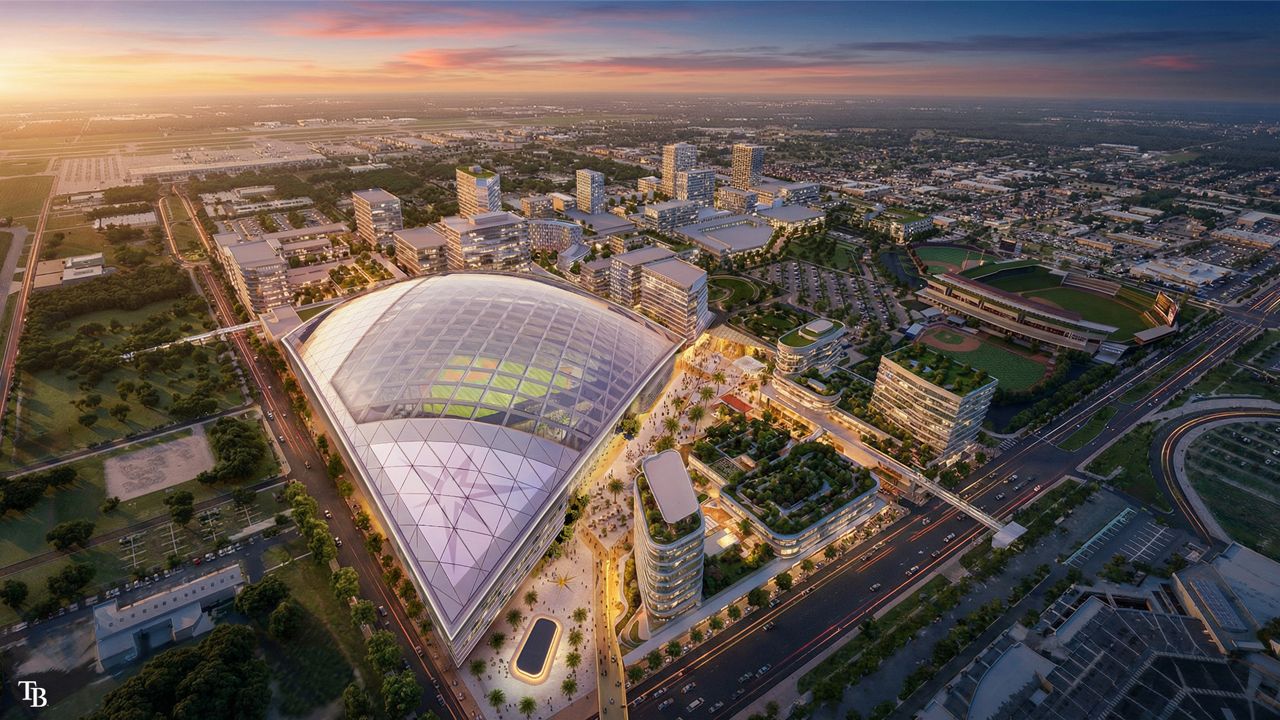
This issue is probably the one I’ve been asked the most about when it comes to the issues that will be before a county commissioner.
And I will honestly admit that I have not fully decided what my stance on this issue is officially. I have three distinct minds on this subject and having been a sports journalist in this area for a very long time, I’ve been there to observe this ongoing saga from up close, from the Al Lang proposal to the Gas Plant.
To say this is a complex issue is an understatement.
As a fan myself, and the father of a young baseball fan, the idea of a baseball-centric megaplex actually sounds pretty awesome. Me and my Kid have lots of fond memories of attending games at the Trop and I’d like to continue having those memories for the rest of our lives.
As a journalist, I’ve spent a lot of time around the team covering everything from rookies trying to break camp in spring training to covering a World Series. I was directly on the MLB.com payroll for seven seasons. Those paychecks paid for my kid’s travel ball and more than a few truck payments. I’ve made many friends and acquaintances in and around that team. I have to be acutely aware of any potential biases I might have in order to remain objective on all issues.
Because, as a potential commissioner, it is my duty to look out for the best interests of everyone in the county who pay taxes, many of which will never see the inside of that stadium. Truth and transparency has to be at the forefront of everything. It is already becoming a major issue. There is too much money involved. Too many stakeholders trying to claim their share. Too many backroom deals. Too many hands trying to get their piece of the pie.
To be the voice of reason in rooms full of powerful people is a tall task, especially if I might have to be the wrench in the gears to bring it to a grinding halt.

The Scoreboard
On April 15, 2026, the Hillsborough County Commission is scheduled to take up the financing package for a proposed $2.3 billion Tampa Bay Rays stadium on the Dale Mabry campus of Hillsborough College. Tampa City Council is expected to follow the next day. If both bodies say yes, it will trigger the most significant public spending decision in Hillsborough County’s recent history — a commitment of more than a billion taxpayer dollars toward a professional sports facility on land that currently serves 45,000 college students.
This is not a hypothetical. This is happening right now. And if you live in District 1 — in Ruskin, Apollo Beach, Riverview, Sun City Center, or anywhere in the South Shore corridor where roads are crumbling and water infrastructure is playing catch-up with approvals the commission already signed — you have a direct stake in how this vote goes.
Here is what you need to know.
How We Got Here: A Very Florida Story
The Tampa Bay Rays have been trying to get out of Tropicana Field for the better part of twenty years. The Trop opened in 1990, was never designed for baseball, and has spent decades as one of the most criticized venues in professional sports. Its location in St. Petersburg — across the bay from the larger population base in Tampa — has been blamed for chronically low attendance despite the team fielding consistently competitive rosters.
The most recent attempt to solve the problem was a $1.3 billion stadium deal centered on the Historic Gas Plant District in St. Petersburg, adjacent to Tropicana Field. In July 2024, both the Pinellas County Commission and the St. Petersburg City Council had approved public funding — $312.5 million from the county and $287.5 million from the city. The project appeared to be on track.
Then Hurricane Milton arrived in October 2024 and ripped eighteen of the stadium’s twenty-four fiberglass roof panels to shreds. The Rays spent the entire 2025 season playing at George M. Steinbrenner Field — the Yankees’ spring training facility across the bay in Tampa — while a $59.7 million repair and renovation project got underway at the Trop. The hurricane damage, combined with post-storm construction cost inflation and financing delays by Pinellas County, drove the estimated cost of the St. Petersburg project past what the former ownership group would accept. In March 2025, the Rays formally walked away.
What happened next moved with unusual speed. A new ownership group led by Jacksonville homebuilder Patrick Zalupski closed on the purchase of the team in October 2025. Within 100 days, the new owners had signed a memorandum of understanding with Hillsborough College, earned a unanimous vote from the county commission to begin negotiations, secured a state land transfer from the DeSantis Cabinet, and released initial renderings of their proposed “forever home.” Governor DeSantis and MLB Commissioner Rob Manfred appeared together in Tampa to endorse the project. The momentum was deliberate and fast — remarkable, as these things go.
The Proposal: What’s Actually Being Built
The Rays are proposing a 30,000-seat, fully enclosed stadium on approximately 130 acres in Tampa’s Westshore District — the 113-acre Dale Mabry campus of Hillsborough College, plus about 22 additional acres of state land transferred by the DeSantis Cabinet in February 2026. The site sits directly across Dale Mabry Highway from Raymond James Stadium, home of the Tampa Bay Buccaneers, and adjacent to Steinbrenner Field, the Yankees’ spring training facility where the Rays played last season.
The Rays have packaged the stadium as the centerpiece of a broader mixed-use development the team is calling a ballpark district. The plan divides the site into four areas: a Champions Quarter containing the stadium and surrounding entertainment and retail; an Innovation Edge integrating a rebuilt Hillsborough College campus with health, sports science, and workforce development spaces; The Row, a central street connecting the development; and The Canopy, described as open parkland with shade and greenery. The team projects the development will attract 10 million annual visitors, support nearly 12,000 on-site jobs, and generate $34 billion in direct economic impact over 30 years. None of these figures have been independently verified.
The college, which would be demolished and rebuilt on the southwestern corner of the property, would receive a rebuilt campus and is seeking $50 million in state appropriations for the transition. The college’s board of trustees has signed a nonbinding memorandum of understanding with the Rays on a 99-year land lease structure.
The Rays have committed to paying at least 50% of the stadium’s construction cost — approximately $1.15 billion — and have said they will absorb 100% of cost overruns. That leaves the other half, more than $1 billion, to come from public sources: Hillsborough County, the City of Tampa, and various state and special district mechanisms. The Rays’ target opening is 2029. The Rays’ current lease at Tropicana Field runs through the 2028 season.
The Controversy: Whose Money Is This?
Proposing a stadium is easy. Explaining who pays for it is where the trouble starts.
The Rays have outlined a menu of potential public funding sources: the Tourist Development Tax, Community Redevelopment Agency property tax increment revenue, Community Development Districts, the Westshore Hotel and Motel Special Assessment Fee, the Florida Sports Development Program, stormwater infrastructure funds, facility rent charges, ticket surcharges, investment earnings, a new Entertainment District Retail Use Tax, and a new Rental Car Surcharge.
But the most contentious item on that list — and the one that has ignited the sharpest conflict on the Hillsborough County Commission — is the Community Investment Tax.
The CIT is a half-cent sales tax that every person who buys something in Hillsborough County has paid since 1996. It has raised more than $3.5 billion and funded 784 public projects including fire stations, roads, parks, and the original Raymond James Stadium debt. In 2024, voters narrowly approved renewing the CIT through 2041. The ballot language — approved by a 52% majority — committed the revenue to infrastructure for transportation and public works, public safety, public facilities, public utilities, and public schools.
Here is what the ballot language did not say: new professional sports stadium.
That omission was not an accident. Commissioner Joshua Wostal has said on the record that the phrase “community stadium” was deliberately removed from the ballot language before the 2024 referendum — because commissioners at the time believed including it would cause the measure to fail. “You promised the people that you wouldn’t use the CIT tax,” a member of the public told commissioners at a meeting this week. “You took it out of the referendum because you didn’t think it was going to pass.” Carmen Edmonds, chair of the Hillsborough Republican Party, echoed the concern: “That CIT money, as promised in the referendum when we voted on it in ’24, was only to be used for infrastructure, fire stations and existing stadiums.”
Commissioner Wostal has been unambiguous about what he sees coming. “I want to be clear,” he said at an April 2026 commission meeting. “It’s not if we’re going to be sued on this. It’s when we get sued on this if we use CIT for a new professional sports stadium.”
Commission Chair Ken Hagan, who has been driving the stadium negotiations, has been equally unambiguous from the other direction. “This agreement does not happen without CIT funding. It just doesn’t,” Hagan said. “I want to be honest about that. I don’t want to play games with that.”
The county attorney has said she will seek an outside legal opinion on whether the CIT can be used for the project. Commissioners acknowledged this week that if CIT funding is ultimately part of the deal, legal challenges are likely.
Behind all of this is a transparency fight that is intensifying as the April 15 vote approaches. Commissioner Wostal has pushed repeatedly to release all negotiation documents to the public. His motion to do so was voted down by the full commission. The county attorney ruled on April 1 that draft documents, notes, and proposals generated by county staff during negotiations are not public record — meaning they do not have to be released before the vote. Commissioner Wostal has said he is afraid of a last-minute deal that could keep taxpayers on the hook for decades with no meaningful public review.
At public meetings, residents have been raising the same question from multiple directions: If voters were told the CIT would not fund a new sports stadium, and it turns out the stadium cannot be built without CIT funding, who exactly authorized this negotiation?
The Environmental Questions Nobody Is Answering
The stadium proposal has received extensive coverage of its costs, its renderings, its economic projections, and its political dynamics. It has received very little coverage of what a 130-acre stadium and mixed-use development on a previously undeveloped urban campus will do to the surrounding environment and infrastructure.
Here is what we know, and what we should be demanding answers to.
Traffic is the most obvious concern. Dale Mabry Highway is already one of the most congested corridors in Hillsborough County. The Rays project the development will attract 10 million visitors annually — an independent analysis has suggested that on an average day, not even a game day, the stadium district could add more than 25,000 daily visitors to the area. Hillsborough College students who attended the first public forum meeting in March raised concerns about construction and traffic impacts on their campus. The question of how Dale Mabry handles 30,000 baseball fans exiting simultaneously, combined with the existing Buccaneers and Yankees game-day traffic from adjacent Raymond James Stadium and Steinbrenner Field, has not been seriously addressed in public.
Stormwater is where the environmental questions get harder. The Westshore District — the area around Dale Mabry and West Tampa Bay Boulevard where the stadium would be built — already has documented stormwater deficiencies. The county’s own menu of potential public funding sources for the stadium includes “infrastructure funds to address stormwater deficiencies in the area.” Read that again: the county is considering using the same funding package that finances the stadium to also fix the stormwater problems that will be made worse by building it.
Converting 130 acres of college campus — with its existing green space, athletic fields, and permeable surfaces — into a dense stadium district with a $2.3 billion enclosed ballpark, surrounding hotels, office towers, restaurants, and parking structures means a massive increase in impervious surface. More impervious surface means more stormwater runoff. More runoff in the Westshore District means more pressure on the drainage systems that flow toward Hillsborough Bay. This is the same Hillsborough Bay that lost more than 428 acres of seagrass between 2020 and 2022. This is the same bay whose water quality has been degraded by decades of nutrient runoff from developed land throughout its watershed.
The Rays’ public materials do not address stormwater management in any detail. The commission has not demanded an independent environmental impact assessment as a condition of the funding negotiations. The renderings show attractive green spaces and tree canopies. What they do not show is a drainage system, a stormwater retention plan, or any analysis of the project’s impact on Hillsborough Bay’s long-struggling ecosystem.
The campus displacement is worth noting too. Hillsborough College serves more than 45,000 students, many of them working adults from South Hillsborough County communities — Ruskin, Brandon, Riverview — who depend on affordable, accessible higher education. The MOU proposes relocating and rebuilding the college on the southwestern corner of the property. Construction is projected to begin in late 2026 for a 2029 stadium opening. That means years of disruption for tens of thousands of students from the same communities that are already absorbing the construction impacts of the One Water Program’s pipeline network, the South Hillsborough Transmission Pipeline, and the continued approval of new residential development on an infrastructure system that cannot keep up.
What the Commission’s Role Actually Is
The Hillsborough County Commission is not a passive observer of this process. It is the decision-maker. And the April 15 vote — if it happens on schedule — will be one of the most consequential decisions this commission has made in a generation.
Here is what the commission controls:
The funding commitment. The commission controls whether any public money from Hillsborough County goes to this project, how much, from what source, under what legal structure, and subject to what accountability provisions. This is not a rubber-stamp. It is a billion-dollar decision made on behalf of every person in Hillsborough County who pays a sales tax, uses a county road, or relies on a county park, fire station, or water system.
The land use and development agreements. The stadium and surrounding mixed-use development will require rezoning, land use plan amendments, development agreements, and infrastructure commitments. The commission controls these processes. Every condition it attaches — or fails to attach — to the development approval determines what actually gets built, how stormwater is managed, what traffic mitigation is required, and whether the public gets meaningful community benefits or simply a stadium with a nice rendering.
The environmental review requirements. The commission has the authority to require an independent environmental impact assessment as a condition of the funding agreement. It has not done so. A commissioner who takes environmental stewardship seriously would insist that a project of this scale — on land that drains to a bay that is already in documented ecological distress — be subject to rigorous, independent environmental review before a single public dollar is committed.
The stormwater accountability. The commission oversees stormwater management in unincorporated Hillsborough County and has authority over stormwater standards for development in the stadium’s drainage corridor. If this project is going to add impervious surface and increase stormwater runoff to the Westshore District, the commission should be demanding that the stormwater mitigation plan be designed, permitted, and funded before construction begins — not treated as an afterthought to be addressed with the same public money being used to build the stadium.
The CIT legal exposure. If the commission votes to use CIT funds in ways that contradict the ballot language voters approved in 2024, it is taking on legal liability on behalf of every Hillsborough County taxpayer. Commissioner Wostal is right: the lawsuits will come. The commission’s job is to protect taxpayers from that exposure, not to find creative legal mechanisms to route money the voters didn’t authorize to a purpose they weren’t asked about.
Where J Scott Stands (For Now)
Let me be direct, because that is the only way I know how to operate.
I am a lifelong baseball fan. I grew up watching the Rays. I reported on the team for the Tampa Tribune and MLB.com. I believe Tampa Bay deserves a Major League Baseball team with a real home — whether in St. Petersburg or Tampa.
But I am running for Hillsborough County Commission District 1, not for Rays season tickets.
And from where I sit — in Ruskin, watching the county approve the One Water Program as a catchup investment for growth the commission already approved without adequate infrastructure, watching the South Hillsborough Pipeline tear through neighborhoods for the next five years because someone kept saying yes when the right answer was not yet, watching impact fees get raised 126% on new development because decades of undershooting them left the public holding the bag — the question is not whether the Rays deserve a new stadium.
The question is whether Hillsborough County can afford to commit more than a billion dollars of public money to a professional sports facility when its roads are congested, its stormwater systems are documented as deficient, its water infrastructure is running five years behind, and its southern communities have been systematically underfunded for decades.
The question is whether the commission should be directing CIT dollars — money voters approved to fund fire stations, roads, and schools — to a stadium whose team CEO has said it generates $34 billion in economic impact without providing a single independently verified number.
The question is whether a project that will add 130 acres of impervious surface to the watershed of a bay that already lost half its seagrass in two years should be approved without a comprehensive environmental impact assessment.
And the question — the most fundamental one — is whether the Hillsborough County Commission has the right to commit a billion dollars of public money in a negotiation process where draft documents are not public record, where the CIT legal exposure is acknowledged but unresolved, and where the vote is being pushed toward a deadline that serves the team’s 2029 opening day timeline rather than the public’s need for deliberate, transparent decision-making.
I do not oppose the Rays. I oppose the commission doing what it has always done: saying yes to the concrete merchants and the big-dollar interests at the expense of the people who actually live here, work here, and pay the taxes that fund everything else.
If this deal can be structured with genuine taxpayer protections, full environmental review, legally defensible funding mechanisms, real stormwater accountability, and honest economic analysis — then let’s have that conversation. That is what stewardship looks like.
If it cannot — if the only way to make the numbers work is to redirect money voters were told would go to fire stations, schools, and roads into the coffers of a $2.3 billion stadium project owned by a billionaire homebuilder who closed on the team four months ago — then the commission’s answer should be the same as the one it almost never gives: not yet.
One thing I can say for sure, as a former sports journalist, I’ve been asking these questions from the other side of the dais for decades. I would continue to be the one asking the hard questions of everyone involved in this process. And no matter what my former feelings or allegiances may be, I would be an objective voice of the people of Hillsborough County, making sure that there is truth and transparency in the process all the way until the first pitch is thrown.
“Keep it Florida, Man!”

SOURCES & FURTHER READING
WUSF — “Possible Rays stadium deal creating friction on the Hillsborough County Commission” (Apr 2, 2026)wusf.org — CIT friction and commission debate
Bay News 9 — “County officials take another step in Rays’ stadium proposal” (Apr 1, 2026)baynews9.com — April 15 vote set, documents not public record
Bay News 9 — “Public asks Rays CEO about CIT funding” (Apr 3, 2026)baynews9.com — Latest community meeting coverage
WTSP — “Tensions rise over Rays stadium deal as Hillsborough leaders debate transparency, funding”wtsp.com — Transparency, legal challenges likely
Tampa Bay Times (28) — “Hillsborough County Commissioners consider using voter-approved tax fund for $1.2B Rays stadium”tampabay28.com — CIT breakdown and funding sources
WUSF — “Hillsborough commissioners’ vote on Rays stadium financing delayed till mid-April” (Mar 23, 2026)wusf.org — Vote delayed to April 15
FOX 13 — “Rays unveil renderings for proposed $2.3B stadium at Hillsborough College” (Feb 5, 2026)fox13news.com — Renderings and project overview
FOX 13 — “Rays stadium funding: Could the Community Investment Tax be used?” (Feb 6, 2026)fox13news.com — CIT legal and voter consent debate
Florida Politics — “Cabinet’s land transfer vote gives Rays’ ballpark bid a big boost” (Feb 24, 2026)floridapolitics.com — DeSantis Cabinet 22-acre land transfer
St. Pete Catalyst — “Rays pitch their plan for a stadium on Hillsborough College site” (Mar 2026)stpetecatalyst.com — First public meeting coverage
Construction Dive — “Tampa Bay Rays unveil designs, plans for $2.3B ballpark” (2026)constructiondive.com — Project design and construction overview
Tampa Bay Times — “How would a Rays stadium off Dale Mabry affect traffic, parking?” (Jan 24, 2026)tampabay.com — Traffic and parking concerns
AP / NBC Sports — “Tampa Bay Rays’ new stadium proposal: What we know so far” (Jan 28, 2026)nbcsports.com — Full stadium saga overview
Wikipedia — Gas Plant Stadium (full project history)en.wikipedia.org/wiki/Gas_Plant_Stadium