
Florida’s conservation lands are under threat — and Hillsborough County’s forgotten phosphate legacy puts District 1 directly in the crosshairs.
There is a place in Polk County, just northeast of Lakeland, that most people in the Tampa Bay area have never heard of.
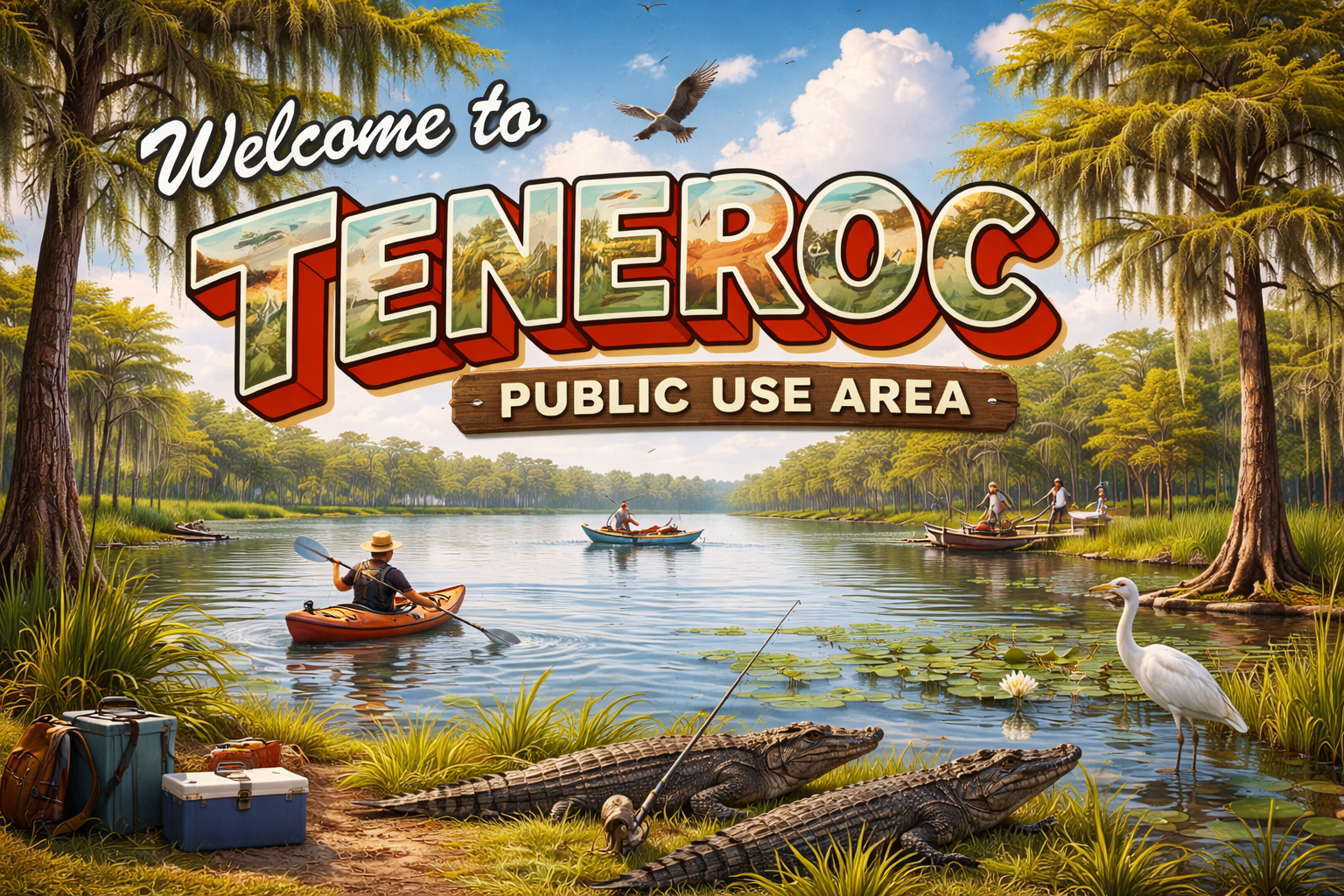
It is called the Tenoroc Public Use Area. Twenty-nine fishing lakes. Seventeen miles of hiking trails. Nineteen miles of equestrian trails. Nesting osprey in the spring, migrating songbirds in the fall, trophy largemouth bass year-round. Birdwatchers drive hours to walk the trails around Cemetery Lake and spot hooded mergansers, common gallinule, and the occasional northern harrier cruising low over the water.
None of it would exist if someone hadn’t fought to protect it.
Before 1982, Tenoroc was a phosphate mine. Borden, Inc. had stripped the land — scraped 30 to 40 feet of overburden from the surface, dredged the phosphate-bearing matrix from underneath, and left behind a landscape of spoil mounds, pit lakes, and disrupted drainage patterns that looked, as one writer put it, “otherworldly.” When Borden donated its 6,065 acres to the State of Florida for conservation and recreation, the state accepted, and the Florida Fish and Wildlife Conservation Commission went to work. Decades later, what was once an industrial scar is one of the most popular public fishing destinations in Central Florida.
That story matters right now — because the forces that could undo it are moving faster than most people realize.
And they are heading straight for Hillsborough County.
The New Threat: Selling Conservation Land Back to Development
In 2026, Governor Ron DeSantis signed Florida’s so-called “Florida Farm Bill” into law. Buried inside its provisions is a clause that should alarm every Hillsborough County resident who has ever cast a line in a public lake, hiked a county preserve, or depended on the Floridan Aquifer for their drinking water.
The law creates a mechanism allowing the state to declare certain conservation lands as “surplus” — and sell them for agricultural production.
Let that sink in for a moment. Land that Florida taxpayers purchased specifically to protect it from development can now, under this law, be declared no longer needed and sold off. The provision applies to state-owned conservation land acquired after 2023. And while supporters frame it as a way to create affordable farmland for young farmers — a goal worth supporting in principle — the environmental community’s alarm is not misplaced.
“If conservation lands can be undone after acquisition, no public land is truly protected,” the Sierra Club Florida said in a statement after the bill passed. “Florida taxpayers invest billions of dollars through programs like Florida Forever to secure land for water protection, wildlife habitat and resilience — not to create a revolving door for future sale.”
The revolving door framing is apt. Because this is not the first time the current administration has tried to hand protected land back to private interests. DeSantis faced furious public opposition in 2024 when it emerged that state agencies were considering allowing golf courses, hotels, and pickleball courts inside Florida state parks. Then came a proposed land swap that would have handed state forest land to a golf course developer. Both proposals were reversed after public outcry — the Legislature even passed a bill to prevent future governors from commercializing state parks.
But the surplus land provision survived. And it creates a precedent that Florida conservation advocates, legal experts, and anyone paying attention should be watching closely: once you establish that conservation land can be un-conserved, you have undermined the entire premise of land protection.
The question for Hillsborough County — and for District 1 specifically — is what this means for the tens of thousands of acres of protected land, reclaimed phosphate terrain, and critical aquifer recharge zones that sit in and around the South Shore and East Bay communities.
Hillsborough’s Phosphate Legacy: The Dirty Secret Under Southeast County
Most people driving through Brandon, Riverview, and the communities of southeast Hillsborough County do not think about what is under their feet. But the Bone Valley — the phosphate-bearing geological formation that covers portions of Polk, Hillsborough, Manatee, and Hardee counties — does not stop at any county line.
Phosphate mining in Hillsborough County began in earnest in the mid-20th century. The southeast portion of the county, particularly the area around Balm, was mined extensively. The process was the same one that reshaped Tenoroc in Polk County: massive draglines scooping out 30 to 40 feet of overburden, then 15 to 25 feet of phosphate-bearing matrix, leaving behind pit lakes, clay settling ponds, and spoil mounds. Natural drainage patterns were obliterated. Wetlands that once filtered the county’s water and recharged the Floridan Aquifer were destroyed.
Before 1975, none of this had to be fixed. Florida did not require reclamation of mined phosphate lands until July 1, 1975. Everything mined before that date — called “nonmandatory land” in Florida statute — was left as-is unless someone specifically sought to clean it up. In southeast Hillsborough, that means there are stretches of land that were industrially stripped decades ago and have never been fully restored.
In recent years, Hillsborough County has been actively working to change that — at least in some places. Near Balm, in the Balm Boyette Scrub Preserve, engineers have been using a process called hydraulic carving to recreate a creek that was eliminated by 1960s phosphate mining. Water is pumped to carve channels that mimic the natural drainage patterns that existed before the draglines arrived. It is painstaking, expensive, and necessary — because the creek that was destroyed was not just a scenic feature. It was part of the watershed that fed Saddle Creek, which flows into the Peace River system and ultimately into the Gulf Coast’s marine environment.
That is the phosphate legacy: industrial decisions made decades ago are still reshaping the water, the land, and the ecology of southeast Hillsborough County today.
And the consequences are not abstract. They are the reason certain areas of the South Shore flood when others don’t. They are part of the reason the Floridan Aquifer is under stress in this part of the county. They are the reason some stretches of creek and wetland in District 1 are ecologically diminished — not because of recent development, but because of industrial activity that happened before most current residents were born.
Why Florida Forever Matters — And Why Its Funding Cannot Be Trusted
The primary tool Florida has used to acquire and protect sensitive lands is the Florida Forever program. Since 2019, the state has invested more than $1.4 billion in land conservation through Florida Forever. In December 2024, DeSantis and the Cabinet approved a landmark $318 million package protecting more than 86,000 acres across 15 counties.
Those numbers sound impressive. And the program, when funded and functioning properly, is genuinely valuable. Hillsborough County has been a leader in local conservation land acquisition through the Jan K. Platt Environmental Lands Acquisition and Protection Program (ELAPP), which manages more than 63,400 acres of environmentally sensitive habitat and corridors. Voters have repeatedly and overwhelmingly supported ELAPP funding at the ballot box, going back to 1987.
But here is what the headlines often obscure: Florida Forever’s funding is wildly inconsistent, politically manipulated, and chronically underfunded relative to the pace of development it is meant to counteract.
The 2024-25 state budget included $229 million for Florida Forever — the highest appropriation in 16 years, and a number padded substantially with federal dollars from the previous administration. The next year’s budget cut that to just $18 million. The Governor vetoed part of the cut and restored about $200 million to the acquisition pool — but only after it became clear lawmakers were trying to sweep the money into general revenue.
This is not conservation policy. It is conservation policy theater: large announcements, press conferences in front of scenic landscapes, and ribbon-cuttings at new preserves — while the year-to-year funding that actually drives sustained acquisition and restoration lurches unpredictably between feast and famine.
The new surplus land provision makes this worse. What Florida Forever acquires today can now be declared surplus and sold tomorrow. The program’s permanent value — the reason voters and taxpayers have repeatedly supported it — was that it meant something. That the land, once protected, stayed protected. That assurance is now conditional.
What the County Commission Has To Do With All Of It
Here is where most people’s eyes glaze over — and where it matters most.
The Hillsborough County Commission is not a passive observer of these issues. It is an active decision-maker with authority over some of the most consequential land use decisions in the county. Understanding what that authority includes is essential for any voter who cares about where this district is headed.
Phosphate mining permits: Hillsborough County has its own phosphate mining regulations embedded in its Land Development Code. The Board of County Commissioners has authority to issue, condition, and revoke phosphate mining operating permits for operations within the county. It can set reclamation standards that exceed state minimums. It can require the deeding of reclaimed lands for public use upon termination of mining. It has the power to demand financial responsibility from mining operators to ensure reclamation actually happens. These are not theoretical powers. They are codified in county law — and they are exercised or ignored depending on who sits on the commission.
Comprehensive Plan and land use: The Commission adopts and amends the Hillsborough County Comprehensive Plan, which governs future land use across the unincorporated county. The Future Land Use Map determines what can be built where — and the Commission controls it. Decisions about which lands get designated for conservation versus which get opened up to residential or commercial development flow directly from the Commission table.
ELAPP stewardship: The Commission administers the ELAPP program and makes decisions about which environmentally sensitive lands are acquired and how they are managed. When budgets get tight, the Commission decides whether conservation land management is a priority or an afterthought.
Development approvals adjacent to protected lands: Even when conservation land itself is protected, the Commission controls what gets built next to it. Buffer zones, development setbacks from wetlands and waterways, stormwater management requirements for adjacent developments — all of these fall within the Commission’s authority and directly affect the ecological function of the protected lands they border.
Intergovernmental advocacy: The Commission has a voice — and an obligation — to advocate at the state level when state policy threatens local conservation interests. When the Florida Legislature passes a surplus land provision that undermines the protections Hillsborough County voters have supported for decades, the Commission should be at the table making Hillsborough’s position clear.
The current commission has not been loud enough, fast enough, or independent enough on any of these fronts. The pave-and-profit crowd — the developer-commissioner alliance that treats District 1’s land and water as raw material for the next subdivision — has had the run of this table for too long.
What a Steward-Minded Commissioner Would Do
The issues outlined in this post are not new. They have been building for decades. What is new is the combination of a state-level policy environment increasingly hostile to conservation, a development pressure in southeast Hillsborough unlike anything the county has experienced, and a county commission that has not demonstrated the will to push back.
A steward-minded Commissioner for District 1 would approach these issues differently.
On the phosphate reclamation legacy, the answer is sustained investment in restoration of the disturbed lands in southeast Hillsborough — not just the showcase projects, but the unglamorous, expensive work of restoring drainage systems, rebuilding wetlands, and reconnecting the aquifer recharge zones that industrial activity severed. The county has the authority to require this. It needs the political will.
On the conservation land threat, the answer is aggressive use of ELAPP acquisition authority to protect the highest-priority lands before they become development targets — and vocal, public opposition to any state-level mechanism, like the surplus land provision, that undermines the permanence of local conservation investments. Hillsborough County voters did not approve ELAPP bonds so that the land could be re-declared surplus and sold in a future political cycle.
On the County Commission’s role in phosphate mining oversight, the answer is enforcing Hillsborough County’s own regulations — including radiation standards for reclaimed land, reclamation completion requirements, and financial responsibility provisions — and using the commission’s authority to set reclamation standards that go beyond the state minimum when the evidence supports it.
On the aquifer connection, the answer is recognizing — loudly and repeatedly — that conservation land is water infrastructure, that the loss of wetlands and recharge areas is not an environmental abstraction but a direct cause of the flooding, the water pressure drops, and the aquifer decline that District 1 residents are living with right now.
The bay remembers what the commission forgets.
And in a district built on reclaimed phosphate land, beside a bay that has been stripped and filled and developed to its breaking point, forgetting is not a neutral act.
The Bottom Line
The story of Tenoroc — a ravaged phosphate mine that became one of Central Florida’s finest public fishing and recreation areas — is a story about what is possible when someone fights to protect land instead of selling it off. It is also a cautionary tale: that transformation happened because someone made a different choice at a critical moment. Borden donated that land instead of developing it. Florida accepted it and invested in its restoration. The FWC managed it for the public good.
None of that was inevitable. All of it required people in positions of authority to choose stewardship over extraction.
District 1 has that choice in front of it right now. The surplus land provision is law. The phosphate legacy lands in southeast Hillsborough are not fully restored. The aquifer is under pressure. The concrete tide is moving south. And the commission seat that controls so many of these decisions is up for election in August 2026.
The question is not whether these issues matter. They do.
The question is who sits at that table when the decisions get made.
“Keep it Florida, Man.”
Sources and further reading:
- Florida DEP — Phosphate Mining & Mitigation Programfloridadep.gov/water/mining-mitigation/content/phosphate
- FWC — Tenoroc Public Use Areamyfwc.com/recreation/lead/tenoroc
- WUFT / Pulitzer Center — “The Price of Plenty: Beneath the Surface” (2023)projects.wuft.org/priceofplenty/water-and-land/beneath-the-surface
- Tampa Bay Times — “Bringing phosphate mines back to nature in southeast Hillsborough County” (2019)tampabay.com — Bringing phosphate mines back to nature
- CFPublic / WUSF — “New law lets state sell ‘surplus’ conservation land” (2026)cfpublic.org — New law lets state sell surplus conservation land
- Florida Phoenix — “DeSantis’ plan to hand over preserved land united Florida against him” (2025)floridaphoenix.com — DeSantis plan to hand over preserved land
- WUSF — “DeSantis restores money to buy lands in Florida Wildlife Corridor” (2025)wusf.org — DeSantis restores Florida Wildlife Corridor funding
- Hillsborough County — ELAPP Programhcfl.gov/residents/parks-and-leisure/conservation-lands/elapp
- Hillsborough County Land Development Code — Phosphate Mining Regulations (Article VIII)hillsboroughcounty-fl.elaws.us — Phosphate Mining Regulations
- Florida DEP — Tenoroc Public Use Area Management Plan Amendment (2020)floridadep.gov — Tenoroc Management Plan Amendment (PDF)
- Florida Governor’s Office — Cabinet approves $318M in land conservation deals (Dec 2024)floridaconserve.org — Cabinet approves $318M land deals
- Florida Forever Program — Florida DEPfloridadep.gov/lands/land-and-recreation-grants/content/florida-forever