
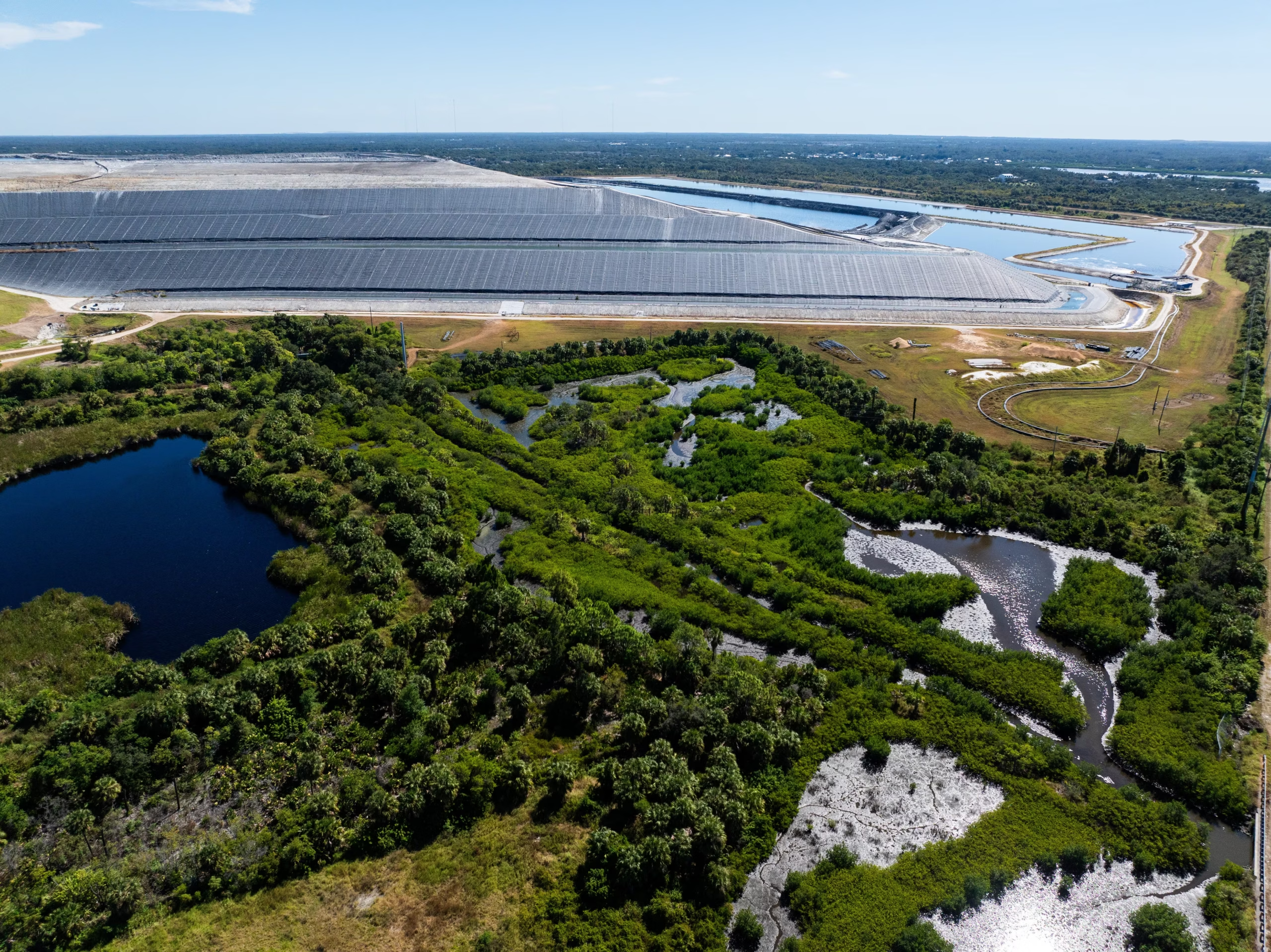
The Riverview fertilizer plant has been operating on the north bank of the Alafia River, just off U.S. Highway 41, since 1924. Most people who drive past it on their way to work every morning do not think much about what is inside.
They should.
The Mosaic Fertilizer plant in Riverview sits on the edge of the Tampa Bay watershed, less than a mile from the shore of Hillsborough Bay. It manufactures roughly 6,000 tons of fertilizer daily — sulfuric acid, phosphoric acid, fluorosilicic acid, ammoniated phosphate products — from phosphate ore mined out of the Bone Valley region east of Tampa. And like every phosphate fertilizer operation in Florida, it produces a byproduct that cannot be used, cannot be safely disposed of, and cannot simply disappear: phosphogypsum.
Phosphogypsum is what is left when you process phosphate rock into fertilizer. It contains radium — the radioactive element from which radon gas decays — along with heavy metals including arsenic, cadmium, and lead. Federal law requires it to be stored in engineered structures called gypsum stacks, or gypstacks, specifically because its radioactive and toxic components cannot be released into the environment. The Riverview plant has two of them. One has been closed. The other — the East Stack — is still active, and it is running out of room.
Mosaic says its East Stack will reach full storage capacity by 2029. So the company is asking for permission to expand it. Nearly 180 acres. Toward U.S. Highway 41. Toward Tampa Bay. Over wetlands and waterways that drain directly into the Alafia River and Hillsborough Bay.
This is not a proposal from a marginal operator with no regulatory history. This is the world’s largest phosphate producer — a Fortune 500 company that, according to state data, owns and operates two-thirds of Florida’s 25 active and closed gypstacks. It is the same industry whose Piney Point facility, also in the Tampa Bay watershed, released 215 million gallons of contaminated wastewater into Tampa Bay in 2021 because its holding pond liner failed and no one in regulatory authority moved fast enough to stop it.
That is the context in which this proposal needs to be understood.
What Mosaic Is Actually Proposing
The project is formally called the Riverview East Stack Extension. Mosaic has entered it into the federal FAST-41 permitting process — a mechanism designed to streamline environmental review for large infrastructure and manufacturing projects — making it the first manufacturing-sector project ever placed on that accelerated track.
The expansion would increase the gypstack’s total footprint by roughly 140 to 180 acres, depending on the source, and make room for an estimated 48 million additional tons of gypsum storage. Mosaic says it would extend the stack’s operational life by about 16 years.
To accomplish this, the company needs to fill in approximately 16.2 acres of waters of the United States — wetlands and other water bodies located west of the current stack, between the facility and U.S. 41. The project area contains approximately 11.7 acres of wetlands and 4.5 acres of other surface waters. Mosaic is seeking a modification of an existing Clean Water Act Section 404 permit from the U.S. Army Corps of Engineers to authorize those fills. It also needs approval from Florida’s Department of Environmental Protection, and from Hillsborough County’s Environmental Protection Commission.
If all permits are approved, construction would begin in 2028 and take approximately two and a half years to complete.
The Trump administration’s Federal Permitting Improvement Steering Council has already toured the project site and expressed enthusiasm for it. “The Permitting Council is proud to support projects that deliver on President Trump’s mandate to bring back domestic manufacturing,” the Council’s executive director said after visiting in December 2025. Mosaic is the country’s largest domestic supplier of phosphate crop nutrients, supplying more than half of America’s annual requirements. At the federal level, the political wind is at its back.
What the Public Is Saying
The Army Corps of Engineers opened a public comment period on the expansion from February 17 to March 19, 2026. It received more than 150 comments.
They are not ambiguous.
On water quality, commenters raised concerns that expanding the phosphogypsum stack toward Tampa Bay increases the risk of leaks, spills, or structural failures that could contaminate Hillsborough Bay, the Alafia River, North Archie Creek, and the Floridan Aquifer — the underground reservoir that supplies drinking water to millions of people across the region. Phosphogypsum’s process water contains radioactive constituents including radium, along with heavy metals. A breach — the kind that happened at Piney Point in 2021, and the kind that happened at Mosaic’s own Mulberry facility in 1997 when a dam breach released wastewater into the Alafia River — would cause contamination that commenters described as potentially irreversible.
On fish and wildlife, commenters flagged that filling the wetlands and creek headwaters west of the stack would destroy tidal mangrove habitat that serves as nursery grounds for snook, tarpon, red drum, and sea trout — the species that define the recreational and commercial fishery of Hillsborough Bay. Concerns were raised about protected species in the project area, including West Indian manatees, sea turtles, smalltooth sawfish, wood storks, and eastern indigo snakes. These are not abstract endangered species lists. These are the fish and animals that live in the waters that District 1 residents fish, paddle, and depend on economically.
On flood and storm risk, commenters repeatedly noted that the proposed expansion area is less than a mile from Tampa Bay, in a low-lying, surge-prone zone, adjacent to the Alafia River. This is the same Alafia River that runs through southeast Hillsborough County, through communities in District 1. The area flooded during both Hurricane Helene and Hurricane Milton in 2024. Commenters pointed out that no updated storm-surge or climate-risk analysis has been produced for the expansion — that the risk modeling was done in a different era, for a stack that was smaller and sat farther from the shoreline.
On public health, commenters cited the radon emissions potential from phosphogypsum, the documented links between proximity to gypstacks and elevated cancer risk, and the particular concern about expanding industrial waste storage closer to densely populated residential communities in Riverview and surrounding areas.
Tampa Bay Waterkeeper executive director Justin Tramble put the economic stakes plainly: “Water quality is the leading industry in Tampa Bay. The marine life, the seagrass, the mangroves — all of that obviously has a significant amount of ecological value, which turns into economic value.” He also identified the regulatory gap at the core of this fight: “The federal government doesn’t elevate phosphogypsum to the thresholds of other toxic chemicals. We understand the need for this industry; what we don’t understand is fast-tracking a permit like this.”
Mosaic’s Offer — and Why It Is Not Enough
Mosaic is not asking for a free pass. Its representatives have offered something in exchange: a pledge to protect more than 300 acres of bayfront property located between the Alafia River and Bullfrog Creek. According to the company, this land contains mangroves, salterns, and upland hardwood forest, and is among the few remaining natural areas along Hillsborough Bay.
“Given its unique location, existing access and nearby utilities, this area could be subject to development pressure if it remains unprotected,” Mosaic’s communications team said.
This offer deserves to be taken seriously — and examined seriously.
300 acres of bayfront conservation along the Alafia and Bullfrog Creek corridor is genuinely valuable. If that land were transferred to permanent conservation easement or public ownership, it would represent a meaningful contribution to the ecological protection of Hillsborough Bay’s western shoreline. That is not nothing.
But the mitigation math requires scrutiny that neither the Army Corps nor the county has yet publicly demanded. You cannot simply credit 300 acres of conservation easement against 180 acres of industrial gypstack expansion and declare the ledger balanced. The two sides of that equation represent qualitatively different things — one is radioactive waste storage in a flood zone next to Tampa Bay; the other is passive land protection in an area already somewhat buffered from development. Independent ecologists, not Mosaic’s own consultants, need to assess whether the proposed mitigation is actually equivalent to the habitat and water quality functions that will be lost when 16-plus acres of wetland gets filled and a radioactive waste pile grows 180 acres closer to the bay.
Federal law requires “no net loss” of wetland functions. Mosaic says its mitigation credits will satisfy that standard. The public comment record suggests that many people who actually live and fish in this watershed are not convinced.
There is also a more fundamental question: should a radioactive waste expansion be permitted by purchase of mitigation credits at all? The entire mitigation credit system was designed for development projects — for roads and subdivisions that inevitably displace some wetland. It was not designed to offset the expansion of a gypstack containing radium, radon precursors, arsenic, cadmium, and lead. These are not equivalent categories of impact.
The Piney Point Shadow
It is impossible to discuss this proposal without confronting Piney Point directly.
Piney Point was also a phosphate industry gypstack. It also sat near Tampa Bay. It also had regulators who reviewed its permits, approved its operations, and accepted the industry’s assurances about structural integrity and containment. And when its liner failed in 2021, 215 million gallons of contaminated wastewater went into Tampa Bay in ten days, delivering nearly 200 tons of nitrogen — a full year’s worth from all other sources combined — into an estuary that had spent decades being restored.
The difference between Piney Point and the Mosaic Riverview facility is scale, not category. Piney Point was a failed and abandoned facility managed by a bankrupt entity. Mosaic is a functioning Fortune 500 company with a long record in Florida — including the 1997 Mulberry dam breach that sent wastewater into the Alafia River, and a 2016 sinkhole at its New Wales facility in Polk County that sent 215 million gallons of process water into the Floridan Aquifer.
In 2025, a coalition of environmental organizations filed suit against the federal government for its failure to adequately regulate radioactive waste from fertilizer production — the exact category of material Mosaic proposes to expand storage for in Riverview. That lawsuit is ongoing.
The pattern is consistent: the industry produces waste that cannot be safely disposed of, stores it in engineered structures that are vulnerable to hurricanes, sinkholes, liner failures, and industrial accidents, and relies on a regulatory framework that has historically treated phosphogypsum as a lower-priority hazard than the scientific evidence suggests it deserves. Mosaic’s Riverview expansion is not an isolated proposal. It is the next chapter of a story that Hillsborough County residents have been living inside for decades.
What the County Commission Has To Do With All of It
Hillsborough County’s Environmental Protection Commission is one of the required permitting authorities for the Riverview East Stack Extension. Mosaic must receive local approval in addition to its state and federal permits before construction can begin.
This is where the Hillsborough County Commission’s role matters — because the Environmental Protection Commission of Hillsborough County is appointed, funded, and overseen through the county government structure. The Board of County Commissioners sets the policy framework within which the EPC operates. A commission that takes environmental protection seriously creates an EPC that takes it seriously. A commission that has historically been accommodating to the pave-and-profit crowd tends to produce an EPC that reaches the same conclusions.
Beyond the EPC’s direct permitting role, the County Commission has several other levers:
Intergovernmental advocacy. The Commission can and should be communicating formally to the Army Corps of Engineers and to FDEP that Hillsborough County’s position on this expansion is grounded in the protection of Tampa Bay, the Alafia River, the Floridan Aquifer, and the communities of southeast Hillsborough County — the same communities that absorbed the environmental and economic damage from Piney Point’s 2021 discharge into a bay they did not cause and could not stop. That position should be on the record before any federal permit is issued.
Independent environmental review. The Commission has authority to require independent, county-funded environmental and hazard analysis as part of its own permitting review — not relying solely on studies commissioned by Mosaic and its consultants. Given the proximity of the expansion to residential communities in Riverview, to the Alafia River watershed, and to Tampa Bay itself, independent storm-surge risk analysis, groundwater impact modeling, and a community health impact assessment are not extras. They are baseline requirements for responsible governance.
Mitigation scrutiny. The Commission should be demanding, as a condition of local approval, that the conservation offset Mosaic has offered — the 300-plus acres of bayfront land between the Alafia River and Bullfrog Creek — be transferred to permanent, publicly held conservation status before any construction begins. Not promised. Not pledged. Transferred, recorded, and legally binding. The pattern in Florida’s phosphate industry is to make mitigation promises before permits are issued and revisit them after the industrial facility is operational and the leverage has shifted.
Land use and zoning authority. The expansion footprint requires land use changes. The Commission controls the Comprehensive Plan and the Land Development Code. A commissioner who understands what is at stake in the Alafia River corridor — who has spent time on those waters, who knows what the seagrass loss in Hillsborough Bay has already cost the fishing community and the bay’s ecosystem — would approach those land use questions very differently than a commissioner who sees the facility as an industrial status quo not worth disrupting.
The Bottom Line
Mosaic is not Piney Point. It is a functioning company with resources, engineers, and a long track record in Florida. It is not wrong to say that domestic phosphate production matters to American food security. It is not wrong to acknowledge that a gypstack has to go somewhere.
But the somewhere cannot simply be wherever Mosaic finds it most convenient. It cannot be 180 acres toward Tampa Bay, over wetlands that filter the water entering Hillsborough Bay, within the flood zone of a river that has already proven its capacity to carry industrial contamination to the estuary, in a county that watched a smaller and less well-capitalized gypstack operation destroy five years of bay restoration in ten days.
The public comment record on this expansion is not the voice of fringe activists. It is the voice of fishing guides, coastal residents, parents, business owners, and people who depend on Tampa Bay’s health for their livelihoods. More than 150 of them went to the trouble of submitting formal comments to the Army Corps of Engineers. They deserve commissioners who read those comments, understand what they represent, and show up in the permitting process as advocates for the county’s water, its shoreline, and its people — not as a rubber stamp for a Fortune 500 company that needs more room for its radioactive waste.
The bay has already absorbed the 1997 Alafia River spill. It absorbed the 2021 Piney Point disaster. It is still absorbing the seagrass losses, the red tide fuel load, the cumulative decades of nutrient pollution that those events accelerated.
It cannot absorb another one.
And a commissioner who has spent a career fighting for these waters — who fishes them, who built a company around protecting them, who founded a conservation publication covering exactly the kind of ecological damage that gypstack failures cause — is not going to show up at that table and wave this through.
SOURCES & FURTHER READING
WUSF — “Mosaic wants to expand its waste pile near Tampa Bay, raising environmental concerns” (Mar 24, 2026)wusf.org — Mosaic expansion and public comment summary
WUSF / Tampa Bay Times — “Mining giant Mosaic wants to expand its phosphate waste stack in Hillsborough” (Nov 9, 2025)wusf.org — Original November 2025 expansion report
Federal Permitting Dashboard — Riverview East Stack Extension project pagepermits.performance.gov — Riverview East Stack Extension
Federal Permitting Council — “Permitting Council Executive Director Tours First-ever FAST-41 Manufacturing Project” (Dec 5, 2025)permitting.gov — Trump admin fast-tracking the Mosaic permit
CLEO Institute — “Mining giant Mosaic wants to expand its phosphate waste stack in Hillsborough” (Nov 2025)cleoinstitute.org — Environmental analysis and background
Waterkeeper Alliance — “New lawsuit challenges federal failure to regulate dangerous phosphate mining waste” (2025)waterkeeper.org — Environmental coalition lawsuit on phosphogypsum regulation
Environmental Protection Commission of Hillsborough County — Permits & Wetlandsepchc.org — EPC wetland permitting authority
Mosaic Florida Phosphate — Riverview Permitting overviewmosaicfloridaphosphate.com — Mosaic’s own permitting description
Florida DEP — Phosphate Mining & Mitigation Programfloridadep.gov — Phosphate mining regulation overview
Thompson Earth Systems Institute — “A Timeline of the Piney Point Wastewater Disaster”floridamuseum.ufl.edu — Piney Point full timeline (context)