
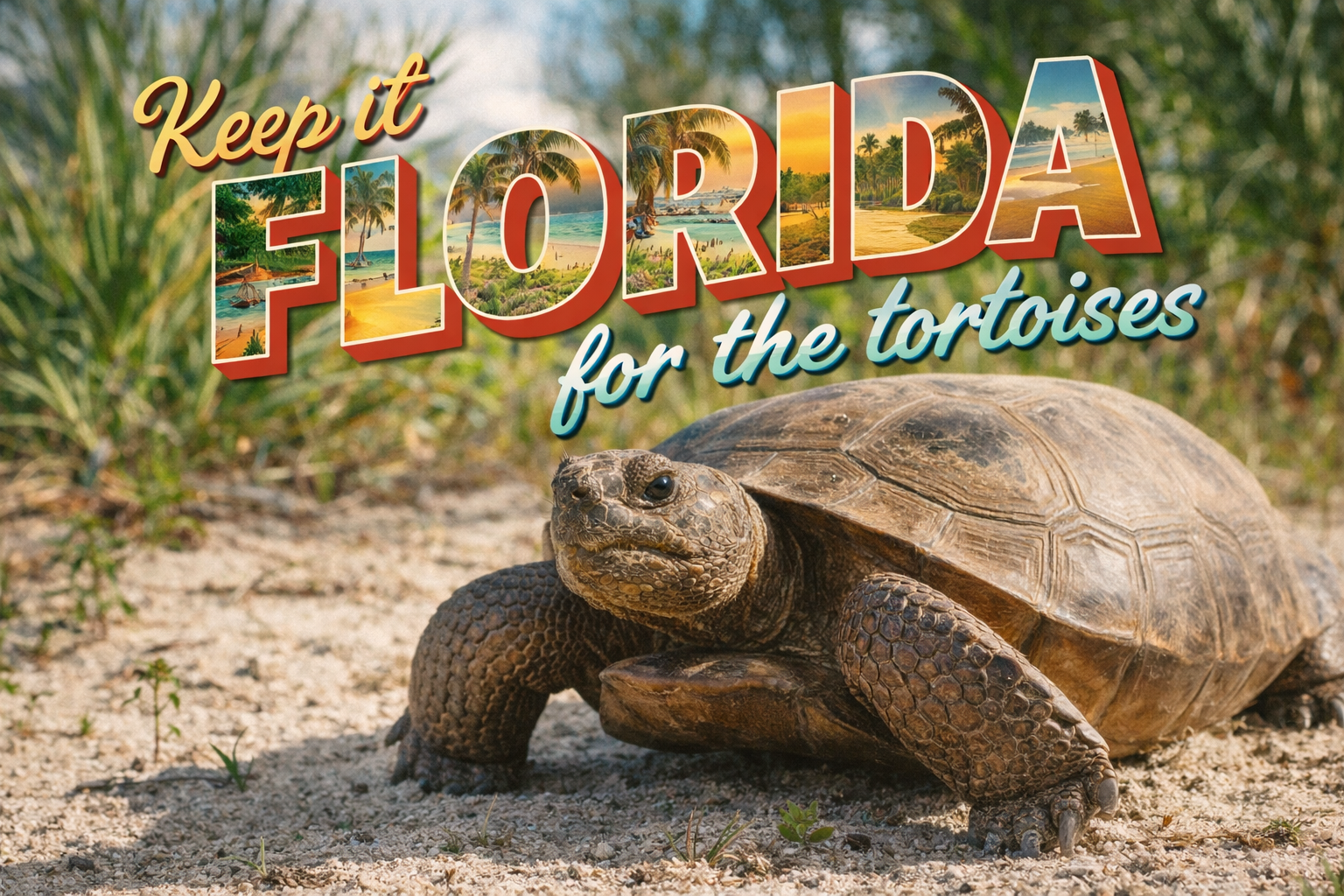
If you have lived in Florida long enough, you have seen one. Crossing a road. Disappearing into a sandy burrow at the edge of a vacant lot. Standing at the end of someone’s driveway with the quiet, unhurried authority of a species that has been doing exactly this for sixty million years.
The gopher tortoise has outlasted the mammoths, the mastodons, the short-faced bear, and every other megafauna that once shared this continent with it. It survived the ice ages, the asteroid that ended the Cretaceous, and five mass extinctions. What it has not been able to survive — what it is actively failing to survive — is Florida’s permitting window.
The gopher tortoise is listed as Threatened in Florida. It has been since 2007. A 2021 study by the U.S. Fish and Wildlife Service projected that by the year 2100, approximately 75% of the current gopher tortoise population could be gone. The U.S. Fish and Wildlife Service reviewed that projection, acknowledged it, and then denied the tortoise Endangered Species Act protection anyway — leaving enforcement to a state wildlife commission whose executive director has spent the past several years finding creative ways to make it easier to move tortoises out of the way of development.
This is not a wildlife story. It is a development accountability story. The gopher tortoise is just the protagonist — the one writing it with its feet, one burrow at a time, in the sandy scrub that is disappearing under subdivision by subdivision in Hillsborough County and across the state.
What a Gopher Tortoise Actually Is
Before the policy, the biology — because you cannot understand what is being lost without knowing what it does.
The gopher tortoise is the only tortoise species native to the eastern United States, found in all 67 Florida counties. It occupies upland habitat: the dry, sandy, open-canopy landscapes of longleaf pine savannas, scrub, sandhill, coastal dunes, and dry prairies — the high-and-dry ground that developers have always targeted first because it does not flood, does not require fill, and drains fast.
It digs. That is its defining characteristic and its ecological significance. A single adult tortoise can excavate a burrow up to fifteen feet deep and forty feet long. It may maintain dozens of burrows throughout its home range over the course of its decades-long life. And those burrows are not just shelter for the tortoise — they are critical habitat infrastructure for an estimated 350 to 360 other species, everything from the eastern indigo snake (itself threatened) to the gopher frog, the Florida mouse, burrowing owls, dozens of beetle species, and dozens more invertebrates that have co-evolved with the tortoise and cannot function without what it builds.
This is why ecologists call the gopher tortoise a keystone species. Remove it from a scrub ecosystem and you do not simply lose a tortoise — you pull the keystone out of the arch. The indigo snakes lose their den sites. The gopher frogs lose their refugia from fire and drought. The rare beetles lose their microhabitat. The whole community of species that evolved alongside the tortoise in Florida’s upland ecosystems begins to unravel, one dependent species at a time.
That 350-species number is not a talking point. It is a documented ecological relationship that took millions of years to develop — and that is being dismantled at the pace of Florida’s permitting queue.
The 97% That Is Already Gone
Here is the number that should stop every county commissioner in Florida cold before they sign the next subdivision approval: 97%.
Gopher tortoises have already lost 97% of the longleaf pine savannas they historically occupied. Ninety-seven percent. The longleaf pine ecosystem — which once stretched in a nearly continuous band from Virginia to Texas, covering somewhere between 60 and 90 million acres of the American South — has been reduced to approximately three million acres. In Florida, what remains is fragmented, managed, and shrinking. The dry scrub and sandhill communities that serve as tortoise habitat in the central and southern peninsula are even more precarious.
This is the landscape baseline against which every new development approval in Hillsborough County should be measured. We are not building on abundant, resilient ecosystems with room to spare. We are building on the last three percent of something that took 10,000 years to develop after the last ice age and cannot be reconstructed with mitigation credits and a check.
The Florida Wildlife Federation puts it plainly: urbanization and land conversion have fragmented tortoise habitat to the point where tortoises are forced to cross roads more frequently to find mates, nesting sites, and forage — increasing road mortality, especially for the females that travel farthest and carry the reproductive future of any population. Fire suppression — the result of building subdivisions up against wild land edges — has allowed the oak scrub to close in on the open sandy habitat tortoises need, degrading remaining patches even where development has not arrived yet.
The population estimate for Florida is currently between 700,000 and 800,000 individual tortoises. That sounds substantial until you understand that gopher tortoises live 40 to 60 years, reach sexual maturity only after 16 years, and produce small clutches of eggs in sandy nest sites that are extremely vulnerable to predation, drought, and disturbance. A population that loses more animals than it produces does not recover on a human timescale. The 75% decline projected by 2100 is not a distant scenario. It is the trajectory we are already on.
Move the Turtle, Pave the Land
Florida’s current system for managing gopher tortoises on development sites was designed with good intentions and has been systematically stressed to the point of crisis by the volume of development it is being asked to process.
Before 2007, it was worse. From 1991 to 2007, the FWC issued what were called Incidental Take Permits — a mechanism that allowed developers to legally bury gopher tortoises alive in their burrows, in exchange for a fee. The state issued approximately 94,000 of these permits in sixteen years. The tortoise population dropped sharply enough that biologists raised alarms, and in 2007 the FWC eliminated the Incidental Take permit and required that all tortoises on development sites be relocated to licensed recipient sites — protected land capable of sustaining a tortoise population permanently.
The relocation requirement is a genuine improvement. It means tortoises are no longer legally entombed. But it has created its own structural problem: the scale of Florida’s development boom has overwhelmed the supply of quality recipient sites. FWC data shows more than 2,000 active gopher tortoise relocation permits issued statewide in a recent twelve-month period. A nonprofit biologist running one of the most respected recipient sites in the Panhandle told a reporter that his facility was receiving dozens of calls per week from consultants desperate to find somewhere to send tortoises from Central and South Florida development sites. The demand for relocation sites has driven up their cost dramatically — creating pressure on developers to find ways around the permitting system, and pressure on regulators to accommodate that pressure.
In 2021, in direct response to this crisis, the FWC’s executive director issued an executive order that broadly waived the rule prohibiting the relocation of tortoises more than 100 miles from their origin. The 100-mile rule had existed specifically to ensure that tortoises relocated from peninsular Florida were not dumped into Panhandle populations where genetic and ecological conditions are different and where their long-term survival is uncertain. The Center for Biological Diversity called the executive order “deeply disappointing and dangerous” and warned that it amounted to a temporary storage solution rather than conservation. “For years the state has enabled sprawl development by simply moving tortoises out of the way,” said Elise Bennett, senior attorney at the Center. “Now there’s nowhere left to put them.”
The core criticism from conservation biologists is not that relocation is useless — it is that relocation has become the entire policy, replacing the thing that would actually work: preserving the habitat where the tortoises already live. Moving a tortoise 100 miles from its home range is not conservation. It is displacement management for the benefit of the approval machine, not the tortoise.
Nobody who understands gopher tortoise biology believes that a relocated tortoise always fares well. The animals are site-faithful — meaning they return to the same burrows, the same home ranges, year after year for decades. A tortoise moved to an unfamiliar recipient site must establish new burrows, find new food sources, and navigate new competition with tortoises already on that land. Research on whether relocated tortoises survive and reproduce at the same rates as tortoises left in their native habitat is, as documentary filmmaker Brent Fannin noted in his 2024 film on the subject, simply not there. “There’s no research done on whether or not it’s okay for us to move that far, whether or not they’re actually healthy and live after that happens,” Fannin said.
The system, in other words, is optimized for development throughput — not tortoise survival.
Hillsborough County: The Scrub Is Almost Gone
Hillsborough County is not the Florida Panhandle. It is not the scrub interior of Highlands County or the longleaf pine woodlands of the Apalachicola region. The upland habitat that gopher tortoises depend on in Hillsborough County — the remaining patches of dry sandy scrub, sandhill, and scrubby flatwoods in the southern and eastern portions of the county — is a finite and rapidly diminishing resource, squeezed between the development corridor of U.S. 301 to the east, Interstate 75 to the west, the Alafia River to the south, and the suburban wall of Brandon and Riverview to the north.
District 1 is ground zero for this pressure. The South Shore corridor — Ruskin, Apollo Beach, Wimauma, Sun City Center — sits in the transition zone where the coastal lowlands meet the upland scrub communities that run through eastern Hillsborough toward the Bone Valley. Every new subdivision approved in that corridor is a choice about what kind of land gets converted. When the high-and-dry scrub goes under a subdivision, it does not come back. The sand pines do not regrow. The wire grass does not recover. The gopher tortoises get relocated, which is to say they get moved somewhere else and the problem of what happens to them afterward becomes someone else’s concern.
This is not abstract. There are active tortoise populations in southeast Hillsborough County. There are documented burrows on lands that have been approved for development, are in the permitting queue, or are being actively cleared right now. Every week that the commission rubber-stamps another density bonus or waives another environmental review condition is another week that the last fragments of upland habitat in District 1 get a little smaller and a little more isolated.
Habitat isolation is particularly dangerous for gopher tortoises because of their biology. A fragmented population — one in which individual tortoises cannot travel between habitat patches to find mates — eventually becomes genetically unsustainable. You can maintain the physical habitat, but if the tortoises cannot access each other, the population collapses anyway. This is why the connectivity of remaining upland habitat in Hillsborough County matters so much, and why every approval that walls off another patch with roads, fences, and houses is a permanent decision, not a temporary one.
What the Commission Controls
The Hillsborough County Commission does not set FWC policy. It does not issue gopher tortoise relocation permits. It cannot override the state’s wildlife management framework. But it controls several things that matter enormously to whether gopher tortoises survive in Hillsborough County over the next twenty years.
Land use decisions. Every rezoning, comprehensive plan amendment, and development order that converts upland scrub habitat to residential or commercial use is a commission decision. The commission can condition approvals on pre-application tortoise surveys, can require that habitat surveys be conducted by biologists not employed by the developer, and can deny or reduce density on parcels with documented tortoise populations when the development design does not leave viable connected habitat on-site. It consistently does not do these things — and consistently approves the projects anyway.
Conservation land acquisition. The county’s Jan K. Platt Environmental Lands Acquisition and Protection Program — ELAPP — provides a mechanism for acquiring and permanently protecting upland scrub habitat in Hillsborough County. The commission sets ELAPP’s budget priorities and approves its acquisitions. A commission that takes gopher tortoise conservation seriously prioritizes ELAPP funding for the remaining high-quality scrub patches in southeast Hillsborough County before those parcels go to developers instead. A commission that does not take it seriously lets those parcels cycle through the permitting queue and gets a relocation permit fee in exchange for the last viable population in a given corridor.
Recipient site investment. The county can invest in establishing and maintaining long-term gopher tortoise recipient sites on county-managed conservation lands — creating capacity within Hillsborough County for the tortoises displaced by development that is already permitted and in process. This is a direct service to the tortoise population and reduces pressure on the broken statewide system that is shipping tortoises 100 miles to the Panhandle because there is nowhere closer to put them. Several Florida counties have done this. Hillsborough has not made it a priority.
Development design standards. The commission has authority over the Land Development Code, which governs how development is designed and what it must protect. A code with teeth would require that developments on parcels with documented tortoise populations demonstrate that viable connected habitat — not just a strip of landscaping and a few fencing requirements — is preserved and managed on-site where relocation is avoidable. The current code does not require this. It requires a permit. A permit that allows the tortoises to be moved and the habitat to be paved.
Public advocacy at the state level. The commission can formally communicate to the FWC, to the Florida Legislature, and to federal wildlife agencies that Hillsborough County supports strengthening gopher tortoise protections — including restoring the 100-mile rule, increasing funding for quality recipient sites, and requiring independent biological review rather than developer-funded surveys as the basis for permitting decisions. It can pass resolutions. It can send letters. It can show up. It almost never does.
The Stakes
A gopher tortoise can live sixty years. That means a tortoise alive today in a scrub patch in southeast Hillsborough County could still be alive in 2085 — if the habitat survives. It could still be digging burrows, still hosting indigo snakes and gopher frogs and the hundred other species that depend on what it builds, still doing the ecological work it has been doing since before humans arrived in Florida.
Or it could be relocated to a recipient site in the Panhandle, where the research on its long-term survival is thin, where it does not know the land, where it may or may not establish a new burrow and find a mate and reproduce at the rate that a species living this close to the extinction math requires.
The difference between those two outcomes is not a wildlife commission ruling. It is a county commission vote. It is the moment when a commissioner looks at a development application on a parcel with documented tortoise habitat and asks the question that almost never gets asked at that table: does this approval have to happen here, at this density, without leaving viable connected habitat intact?
The answer, in Hillsborough County, has almost always been yes. Yes, it has to happen here. Yes, it has to happen at full density. Yes, we will take the permit fee and move on.
I have spent my career on Florida’s water, its coastline, its wild places. I built a company around the conviction that you could love fishing and still fight for the fish. I ran a conservation publication for years because I believed that documenting what is being lost is the first step toward refusing to lose it. Also, I like turtles.
The gopher tortoise has been here sixty million years.
It should not take a commission vote to decide it cannot make it sixty million and one.

SOURCES & FURTHER READING
WUSF / WUFT — “The slow battle to save ‘The beating heart of Florida’: The gopher tortoise” (Mar 29, 2024)wusf.org — Habitat loss, relocation debate, 75% population projection
Florida Wildlife Federation — Gopher Tortoise Conservation Overviewfloridawildlifefederation.org — Population data, habitat fragmentation
Florida Fish & Wildlife Conservation Commission — Gopher Tortoise Programmyfwc.com — State-listed Threatened status, burrow protections
FWC — Gopher Tortoise Permitting Guidelinesmyfwc.com — Conservation permit, relocation rules, recipient sites
Center for Biological Diversity — “Florida Order Weakens Protections for Imperiled Gopher Tortoise” (Nov 19, 2021)biologicaldiversity.org — FWC executive order waiving 100-mile rule
The Invading Sea — “Saving gopher tortoises means protecting their homes, not just moving them” (Oct 21, 2025)theinvadingsea.com — Relocation vs. habitat preservation debate
WPTV — “Indian River County development threatens to displace hundreds of gopher tortoises” (Jul 16, 2025)wptv.com — 2,000+ active relocation permits statewide, recipient site crisis
Florida Phoenix — “Waiving rules for moving Florida gopher tortoises helps only developers” (Dec 9, 2021)floridaphoenix.com — 94,000 pay-to-pave permits, recipient site shortage
Manatee County — Gopher Tortoise Recipient Site Programmymanatee.org — Model county recipient site for regional comparison
USDA Natural Resources Conservation Service — Gopher Tortoise, Working Lands for Wildlifenrcs.usda.gov — Private land conservation, ESA status history