
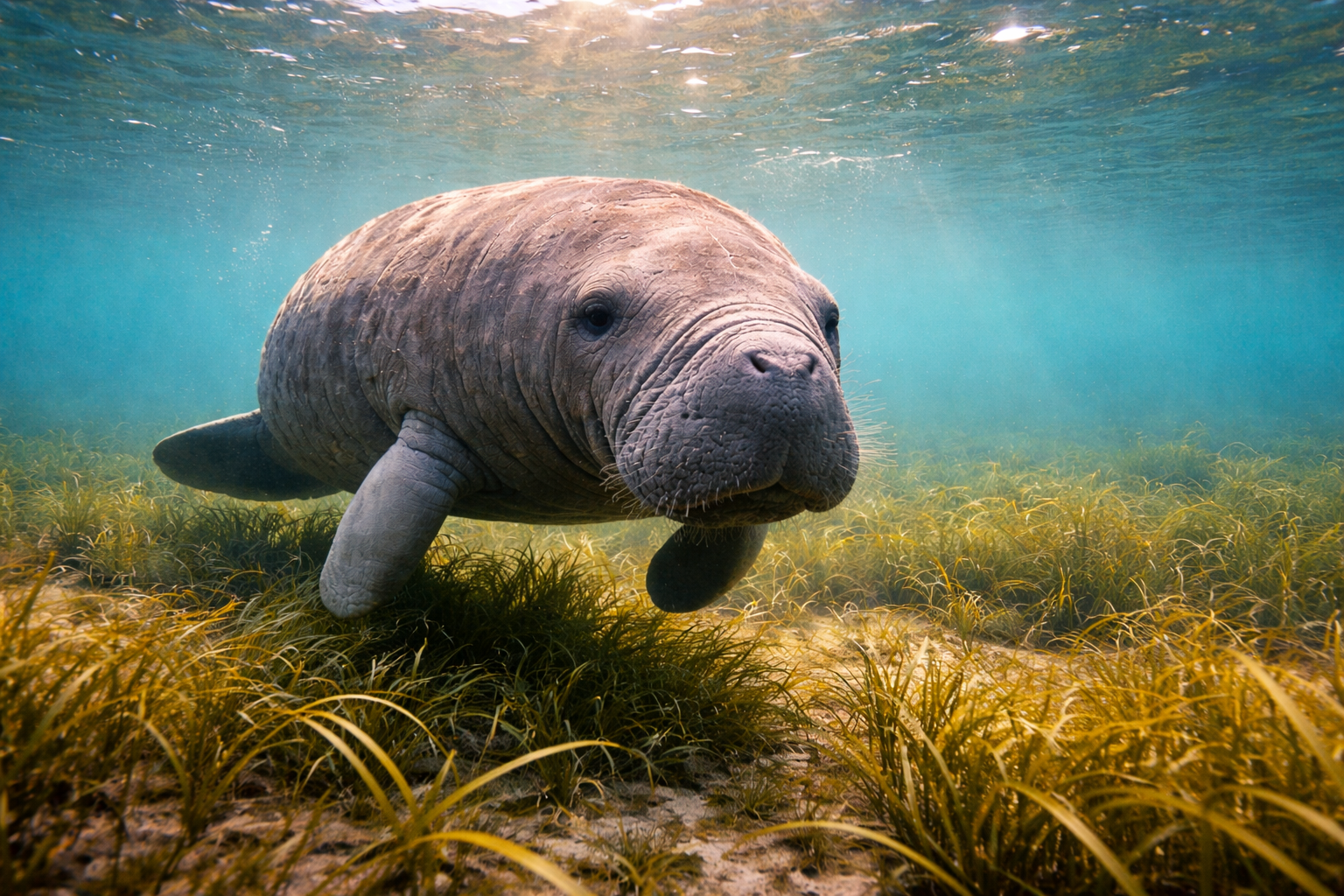
Florida’s lakes and rivers are soaked in glyphosate. The fish know it. The manatees know it. And the people who fish, paddle, and drink from these waterways deserve to know it too.
On any given weekday morning in Florida, contracted spray boats are moving through the state’s lakes and rivers. They are not monitoring water quality. They are not counting fish. They are not restoring seagrass. They are spraying herbicide — most often products whose active ingredient is glyphosate, the same chemical in Roundup, the same chemical at the center of billions of dollars in litigation over cancer claims, the same chemical that a 2021 University of Florida study found in the bloodstreams of 55.8% of Florida manatees tested.
They have been doing this, across Florida’s public waterways, for roughly forty years.
This is not a fringe concern. It is not a conspiracy theory. It is documented, permitted, publicly funded, and happening right now — including in the waterways that drain into Tampa Bay, the bay that defines the ecological identity of Hillsborough County District 1 and the coastline that J Scott Butherus has spent his career fighting to protect.
The question for Hillsborough County residents — and for every angler, kayaker, diver, parent, and person who drinks water treated from this watershed — is whether they know about it, and whether anyone at the county commission table is paying attention.
What Is Happening and Why
Florida has a genuine invasive plant problem. Species like hydrilla, water hyacinth, torpedograss, and paragrass are not native to Florida’s waterways. They grow with explosive speed — water hyacinth populations can double in as little as six to eighteen days — choking navigation channels, outcompeting native vegetation, and disrupting the ecological balance of lakes and rivers across the state.
The Florida Fish and Wildlife Conservation Commission is the state agency responsible for managing these invasive plants under the Florida Aquatic Weed Control Act. And for four decades, the management tool of choice has been chemical herbicide — particularly glyphosate-based products.
In 2017 alone, sixteen different glyphosate products were applied in FWC-funded aquatic plant control programs. Contracted spray crews operate across Florida’s public water bodies, treating invasive vegetation on a continuous basis. By one description circulated among critics of the program, these contractors have been spraying poison into Florida’s aquifer, lakes, rivers, and canals for over forty years — Monday through Friday, forty hours a week.
The FWC argues — and this is worth acknowledging honestly — that the problem is real and difficult. Mechanical harvesting alone cannot keep pace with fast-growing invasive species at scale. In tests on Lake Okeechobee, mechanical harvesters cleared roughly half an acre per day per crew; a single herbicide crew could cover approximately ten acres per day. The logistical challenge of managing hundreds of thousands of acres of public waterway is not imaginary.
But the acknowledgment that the problem is hard does not settle the question of whether the current solution is making things worse.
What Glyphosate Does in the Water
The standard industry and regulatory defense of glyphosate in aquatic environments goes like this: glyphosate works by inhibiting an enzyme pathway found only in plants, not in animals. Therefore, it is relatively safe for fish and wildlife.
That defense contains an important kernel of truth — and it obscures a great deal.
The first problem is formulation. Glyphosate as a pure chemical compound is one thing. Commercial glyphosate-based herbicides — Roundup, Rodeo, Ranger Pro — are something else. They contain surfactants added to make the product more effective: chemicals that help the herbicide stick to plant leaves and penetrate tissue. The most commonly studied of these, a compound called POEA, has been found in laboratory studies to be considerably more toxic to aquatic organisms than the glyphosate itself. The formulation is what goes into the water. The safety claims are often based on the active ingredient alone.
The second problem is chronic versus acute exposure. Regulatory risk assessments focus primarily on acute toxicity — the concentration at which something kills a fish outright in a short-term test. But aquatic organisms in Florida’s lakes and rivers are not exposed to glyphosate for a few days and then removed. They live in it. They feed in it. They reproduce in it. The research on chronic, low-level glyphosate exposure in fish tells a more troubling story.
A 2022 review published in Aquatic Toxicology found that glyphosate-based herbicides can affect fish biochemical, physiological, endocrine, and behavioral pathways at concentrations relevant to real environmental exposure. Studies have documented oxidative stress, liver and gill tissue damage, inhibition of the acetylcholinesterase enzyme — which governs nerve function — disruption of reproductive hormones, impaired ability to escape predators, and DNA damage in blood and liver cells.
Amphibians are particularly vulnerable. Laboratory studies have consistently shown that tadpoles and amphibian larvae are highly sensitive to formulated glyphosate products — a significant concern in Florida, where dozens of amphibian species depend on the same freshwater systems being treated.
The marine invertebrate picture is equally concerning. Research on mussels, clams, and crustaceans — the filter feeders and shellfish that form the base of the coastal food web — has found that glyphosate and its degradation product AMPA affect hemocyte function, enzyme activity, and cellular integrity. These are not animals that swim away from a spray zone. They live in and on the sediment, filtering water continuously, and they accumulate what is in it.
The Phosphorus Problem: Fighting Fire with Fire
Here is the part of this story that should make every Hillsborough County resident’s head spin.
Florida’s water bodies are struggling with excess nutrients — particularly nitrogen and phosphorus — that fuel harmful algal blooms. Those blooms block sunlight, kill seagrass, and destroy the aquatic ecosystems that support fish, shellfish, birds, and the marine environment. Combating nutrient pollution is one of the central challenges of Tampa Bay restoration.
Now consider this: glyphosate is an organophosphate compound. Phosphorus is part of its molecular structure. When glyphosate breaks down in water, it releases phosphorus into the water column.
A 2023 study funded by the Indian River Lagoon National Estuary Program found that while glyphosate at the concentrations detected in the lagoon was not acutely toxic to seagrasses in laboratory settings, the breakdown of glyphosate increased phosphorus levels in the water. The research team flagged this as a serious concern requiring further investigation.
Captains for Clean Water, a Florida-based conservation advocacy organization with deep roots in the fishing and boating community, puts it plainly: the glyphosate spraying programs fuel harmful algal blooms, because nutrients released from dying plants and from the herbicide itself create conditions more favorable to the toxic cyanobacteria that have devastated Florida’s lakes and bays.
In other words: the state is using a phosphorus-releasing chemical to control invasive plants in a system that is already being destroyed by phosphorus pollution. The right hand may not know — or may not want to know — what the left hand is doing.
Tampa Bay Is Already Losing
Hillsborough County residents do not need to look far to see the consequences of degraded water quality in their bay.
Hillsborough Bay — the arm of Tampa Bay closest to District 1, bordered by Ruskin and the South Shore communities — lost more than 428 acres of seagrass between 2020 and 2022 alone. That is a decline of more than half of its total seagrass in just two years. Old Tampa Bay, to the northwest, lost more than 2,500 acres — 38% of its total seagrass — with coverage now at a historic low.
Seagrass is not a decoration. It is the foundation of the bay’s food web: the nursery habitat for snook, redfish, and sea trout; the feeding ground for the manatees that winter in these waters; the buffer that filters nutrients before they reach deeper water. When it disappears, the cascading effects run through every species that anglers pursue and every ecological system that coastal communities depend on.
Glyphosate is not the only culprit. Nutrient runoff from residential lawns, septic system leaching, stormwater carrying fertilizer and agricultural chemicals, and the Piney Point phosphate discharge disaster of 2021 all contributed to the seagrass catastrophe in Hillsborough Bay. But the glyphosate applied in the freshwater systems that drain into Tampa Bay — including the rivers and canals of District 1 — is part of the nutrient load entering the estuary.
A 2024 peer-reviewed study published in the Journal of Marine Science and Engineering examined the specific effects of glyphosate on the seagrass species Halodule wrightii and Ruppia maritima from a subtropical Florida estuary. The researchers found that glyphosate impairs photosynthetic efficiency and foliar growth in seagrass at elevated concentrations, and noted the growing concern about herbicide use within watersheds that drain to these critical coastal ecosystems.
The watershed that includes Hillsborough County’s freshwater systems drains to Tampa Bay. What happens in the canals and lakes of District 1 does not stay there.
The Manatee in the Room
In 2021, Florida manatees experienced an Unusual Mortality Event — the deadliest on record. More than 1,100 manatees died, the majority from starvation caused by the catastrophic seagrass loss in the Indian River Lagoon and Tampa Bay.
In the same year, a University of Florida study found that 55.8% of the Florida manatees tested had glyphosate in their bloodstream. The researchers noted that the chemical may cause organ damage and cancerous tumors. Save the Manatee Club has called for additional research to determine whether glyphosate interference with submerged plants is contributing to manatee starvation.
The connection between herbicide use, seagrass loss, and manatee mortality is not proven as a direct causal chain. The science is still developing. But consider the convergence: the same state agency that is tracking manatee die-offs and funding emergency seagrass restoration is also contracting spray crews to put glyphosate — a phosphorus-releasing, plant-killing compound — into the freshwater systems that feed the estuaries where manatees are starving.
For a fisherman who has spent his career watching the waters of the Gulf Coast, this pattern is not abstract. It is the definition of the approval machine — the system that keeps doing what it has always done, collecting its contracts and filling its workplans, while the bay keeps losing seagrass and the manatees keep dying.
What Is Being Done — and What Isn’t
To the FWC’s credit, the public pressure from anglers, conservationists, and organizations like Captains for Clean Water has produced some response. In late 2019, the FWC established a Technical Assistance Group made up of 30 stakeholders to help develop a new, integrated management strategy for aquatic plants. The agency has committed to exploring expanded mechanical harvesting, improving herbicide timing to reduce conflicts with fishing tournaments and waterfowl seasons, and developing lake management plans that incorporate public input.
These are meaningful steps. They are not sufficient.
The FWC’s program remains structurally dependent on chemical herbicide as its primary management tool. The Florida Aquatic Weed Control Act explicitly exempts herbicide applications to state waters from water pollution operation permits under Florida Statute 403.088 — meaning the spray programs operate outside the normal pollution control permitting process. No other industrial activity dumping chemicals into Florida’s public waterways at this scale would receive such an exemption.
At the local level, the City of Miami passed a resolution to stop using glyphosate on city property after advocates documented that the city had used nearly 5,000 gallons of glyphosate-containing herbicide in a single year. Miami set a model for what local governments can do when they decide the status quo is unacceptable.
Hillsborough County has not followed suit.
What the County Commission Has To Do With All of It
The Hillsborough County Commission is not the FWC. It does not directly control the state’s aquatic herbicide program. But it is not powerless either — and a commissioner who has been paying attention would know that.
On stormwater and runoff: The Commission has direct authority over stormwater management in unincorporated Hillsborough County. Stormwater runoff is one of the primary vectors by which glyphosate — applied on agricultural land, commercial landscapes, and county right-of-way maintenance — reaches the county’s waterways. The Commission’s decisions about stormwater infrastructure, landscaping practices on county property, and pesticide use standards for county contractors directly affect how much glyphosate enters the drainage system that flows toward Tampa Bay.
On county herbicide policy: The Commission controls what chemicals are used on county-managed lands, roadsides, parks, and drainage ditches. A Commissioner who takes this issue seriously could move Hillsborough County toward a policy that eliminates or sharply restricts glyphosate-based herbicide use on county property — following the Miami model — and requires integrated pest management approaches that prioritize mechanical and biological alternatives.
On the agricultural community: District 1 includes some of the most productive agricultural land in Hillsborough County — the East Bay farming region. Agricultural application of glyphosate is, by volume, far larger than the FWC’s aquatic programs. The Commission has a role in working with the agricultural community, through the county’s soil and water conservation resources, to reduce glyphosate runoff from farm fields into District 1’s waterways.
On intergovernmental advocacy: The Commission has a platform and an obligation to advocate at the state level when state practices are harming local water quality. When the FWC’s spray contractors are putting phosphorus-releasing herbicides into the freshwater systems that drain to a bay the county has spent decades and hundreds of millions of dollars trying to restore, the Commission should be saying so — loudly and publicly — in Tallahassee.
On local water quality monitoring: The Commission funds and oversees various water quality monitoring programs. A Commissioner focused on this issue would push for expanded monitoring of glyphosate and its primary metabolite AMPA in the county’s freshwater and coastal systems — creating the data record needed to hold state agencies accountable.
None of this has been happening. The current commission has not been loud enough on the state’s aquatic herbicide program, has not moved county property toward glyphosate-free alternatives, and has not connected the dots between the chemicals going into District 1’s freshwater and the seagrass losses documented in Hillsborough Bay.
What a Steward-Minded Commissioner Would Do
The solution to Florida’s invasive plant problem is not simple. Pretending that mechanical harvesting can replace chemical treatment overnight — without regard for the scale, the speed of plant growth, or the cost — is not honest. The FWC is managing a genuine ecological challenge with limited resources.
But the current approach — spray first, ask questions later, exempt the program from pollution permits, and watch the seagrass disappear — is not working either. It is the chemical dependence that Captains for Clean Water has been documenting for years: a system that defaults to the cheapest and fastest option without accounting for the full ecological cost.
A steward-minded Commissioner for District 1 would push for:
A county-wide glyphosate reduction policy covering all county-managed lands, roadsides, drainage ditches, parks, and contractor operations — with a clear timeline for transition to integrated pest management alternatives.
Expanded water quality monitoring for glyphosate and AMPA in District 1’s freshwater systems and in Hillsborough Bay — because you cannot manage what you do not measure.
Aggressive advocacy at the state level for reform of the Florida Aquatic Weed Control Act’s permitting exemptions, and for increased FWC investment in mechanical, biological, and non-chemical management alternatives — funded in part by redirecting the budget currently committed to chemical contractors.
Coordination with the East Bay agricultural community on best management practices for glyphosate application and runoff reduction — because the farms of District 1 and the bay they drain to are not separate problems.
Public transparency about what is being applied, where, and in what quantities in Hillsborough County’s waterways — because the anglers, the kayakers, the parents, and the people eating the fish from these waters deserve to know.
The bay remembers what the commission forgets. Every acre of seagrass lost in Hillsborough Bay is a record of decisions made and decisions not made at the commission table.
The Bottom Line
Glyphosate is not a small or obscure issue. It is the most widely used herbicide on Earth. It is in Florida’s public waterways by the tens of thousands of gallons annually. It is in the bloodstreams of more than half the manatees tested by the University of Florida. It is likely in the fish caught by anglers on the lakes and rivers of District 1. It may be contributing to the seagrass losses that are restructuring the food web of Tampa Bay.
Fishermen have been raising the alarm about this for decades. Conservation organizations have been pressing for reform for years. The science, while still developing, points consistently toward caution: the formulated products used in Florida’s waters affect fish at the cellular and behavioral level, harm amphibians, accumulate in marine invertebrates, and release the phosphorus that fuels the algae blooms that are killing the seagrass that the manatees are starving without.
This is not a problem that fixes itself. It is a problem that requires someone at the county commission table who understands it, who takes it seriously, and who has the record to prove their convictions are genuine — not a campaign talking point.
I fish this water. I have spent my career reporting on marine conservation and fighting for the fish that call Tampa Bay home. I founded a company because I believed the fishing industry could operate without putting poisons in the water.
I am running for Hillsborough County Commission District 1 because the pave-and-profit crowd is not the only threat to this bay. Sometimes the threat comes from the spray boat moving quietly through the cattails on a Tuesday morning, doing what it has always done, while no one at the commission table asks why.
SOURCES & FURTHER READING
- FWC — Florida Aquatic Weed Control Act (Florida Statute 369.20)myfwc.com/license/aquatic-plants/florida-statutes
- FWC — Aquatic Plant Management Program Enhancementsmyfwc.com — Aquatic Plant Management Enhancements
- UF/IFAS — Background on Registered Aquatic Herbicides (includes glyphosate program detail)plants.ifas.ufl.edu — Registered Aquatic Herbicides
- Captains for Clean Water — “The Fight to Reform Florida’s Dependence on Chemical Herbicides”captainsforcleanwater.org — Florida’s Herbicide Dependence
- Save the Manatee Club — Algae Blooms & Seagrass Loss (includes UF glyphosate/manatee bloodstream study)savethemanatee.org — Algae Blooms and Seagrass Loss
- Fox et al. (2024) — “Glyphosate Herbicide Impacts on Seagrasses from a Subtropical Florida Estuary” — Journal of Marine Science and Engineeringmdpi.com/2077-1312/12/11/1941 — Glyphosate & Florida seagrass (peer-reviewed)
- Indian River Lagoon NEP — Q4 2023 Newsletter (glyphosate/phosphorus/seagrass findings)onelagoon.org — IRL Q4 2023 Newsletter
- Lopes et al. (2022) — Effects of glyphosate on fish behavior and physiology — Aquatic Toxicology (PubMed)pubmed.ncbi.nlm.nih.gov/36103761 — Glyphosate & fish behavior (peer-reviewed)
- Klátyik et al. (2024) — “Aquatic Ecotoxicity of Glyphosate, its Formulations, and Co-formulants: Evidence from 2010 to 2023” — Environmental Sciences Europelink.springer.com — Aquatic ecotoxicity review 2010–2023 (peer-reviewed)
- The Invading Sea — “Tampa Bay Must Restore Its Seagrass” (Hillsborough Bay seagrass loss data)theinvadingsea.com — Tampa Bay seagrass loss
- Miami Waterkeeper — City of Miami glyphosate ban resolutionmiamiwaterkeeper.org — Miami glyphosate ban
- Intechopen — “Ecotoxicology of Glyphosate-Based Herbicides on Aquatic Environment”intechopen.com — GBH ecotoxicology review
- Fight for Zero — “Protecting Starving Florida Manatees from Polluted Waterways”fight4zero.org — Manatees and polluted waterways
- Advocates Voice — “Brevard County to Approve Harmful Spraying on Waterways” (FWC herbicide contract coverage, Jan 2023)advocatesvoice.com — FWC herbicide spraying report