
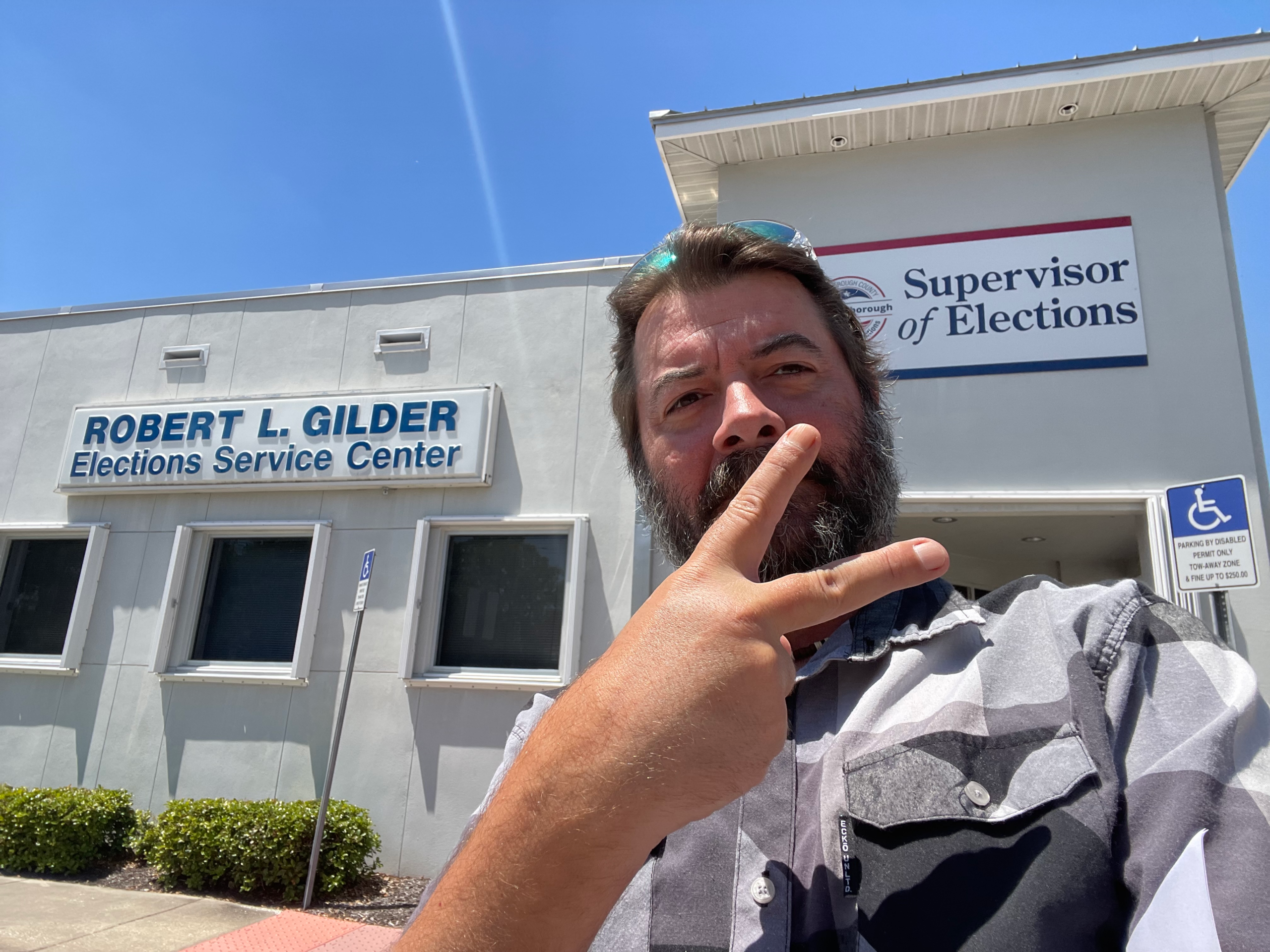
$7,639.20
That’s what it costs to be placed on the ballot for Hillsborough County Commission for the 2026 election. If I wasn’t running without any party affiliation that fee would still be $5,092.80.
There is an alternate path to getting on the ballot. It requires over 8,500 signatures. Valid complete forms.
And even though I was fortunate enough to meet hundreds and hundreds of potential voters at community events and canvassing our local neighborhoods over the last two month, I’ve come to the rational conclusion that there just isn’t enough time to achieve the number needed.
So that is why, I’m officially announcing my withdrawal from the 2026 race for Hillsborough County Commission.
I want to say that plainly before anything else, because you deserve the straight version — not a press release, not a spin job, not a carefully managed exit narrative. You’ve been reading this blog long enough to know that’s not how I operate.
Here’s what happened, what it meant, and what comes next.
The Ballot Access Problem
Running for partisan office in Florida under a minor party is not the same as running as a Democrat or a Republican. The two-party structure is embedded in the mechanics of ballot access in ways that most people — including me, when I started this — don’t fully appreciate until they’re inside it.
To qualify for the ballot, a candidate has one of two options: pay the qualifying fee, drawn directly from the campaign account, or collect enough verified petition signatures from registered voters in the district to waive that fee.
I chose the petition route. For a candidate running without corporate PAC money, without developer checks, without the institutional fundraising infrastructure that feeds both major parties, it seemed like the right choice — a way to build the campaign on community support rather than donor ledgers. I believe in that principle. I still do.
What I underestimated was the math.
Gathering the required number of verified signatures from registered District 1 voters — with a qualifying deadline of June 12, 2026 — requires a ground operation that a one-person grassroots campaign, funded by small donors and built on principle rather than political infrastructure, cannot reliably execute in the available time.
Even if I were gather enough signatures, there would still be a matter of validating those signatures which costs up to 10 cents per form. Unfortunately, even the best intentioned signatures were leaving off vital information on the petitions. They have to come from registered voters within the specific district boundaries. Every signature that doesn’t verify is a wasted door. And every day that passes without a funded, staffed canvassing operation is a day closer to a deadline that does not move. The real number of signatures would probably have needed to be closer to 10k to account for that.
I looked at the numbers honestly. I looked at the timeline. And I made the decision that people who respect their supporters make: I withdrew before the deadline, cleanly, rather than running out the clock on a campaign that could not reach the ballot.
What This Campaign Was
I joined the Ecology Party of Florida in 2017 — nine years before I filed for this race. The convictions came before the candidacy. That is something I said often during this campaign, and I want to say it again now because it is the thing I most want people to remember about what we built here.
This was not a vanity run. It was not a protest candidacy with no intention of winning. It was a genuine attempt by a Ruskin resident, a parent, a journalist, a conservationist, and a person who has been fishing and fighting for Tampa Bay for twenty years to bring a different kind of voice to a commission table that has spent decades saying yes to the pave-and-profit crowd.
I knocked on doors. I sat across from residents in Ruskin, Apollo Beach, and East Bay who told me, unprompted, that they were scared — scared of what is happening to their water, their roads, their cost of living, their coastline. People who had never voted for a third-party candidate in their lives told me they were ready to try something different. That is not nothing. That is, in fact, the whole point.
I learned things I could not have learned any other way.
I learned that the Hillsborough County Commission operates in a political environment where most decisions are shaped long before the public meeting — in conversations between developers, their attorneys, commission staff, and commissioners that rarely surface in the public record. I learned that impact fees, the One Water Program, conservation land acquisition, and gopher tortoise habitat preservation are all connected by the same thread: a commission that has consistently prioritized growth over carrying capacity, and then asked the public to pay for the gap.
I learned what it costs to run outside the system. Not just financially — though the financial reality of a grassroots campaign without institutional backing is severe — but logistically, emotionally, and practically. The ballot access rules in Florida are not neutral. They are designed, at every level, to make it easier to run as a Democrat or a Republican than as anything else. That is not a conspiracy theory. It is a structural fact, and it is worth naming.
I learned that the people of Hillsborough are paying attention. That surprised me, not in terms of caring — I always knew they cared — but in terms of specifics. People in Ruskin know about Piney Point. They know about the aquifer. They know their roads are behind. They know that the subdivision that went up last year is being followed by another one, and another one after that, and they are tired of being told that growth is prosperity when what they experience is congestion, flooding, and rising water bills.
What Comes Next
Running for office and advocating for a community are not the same thing, but they are not opposites either.
I ran for the commission because I believed — and still believe — that the issues facing the Tampa Bay Area require someone at that table who will actually say no. No to the developer who needs one more density variance. No to the approval without demonstrated water capacity. No to the gypstack expansion that edges toward Tampa Bay one permit at a time. No to the stadium deal that redirects voter-approved infrastructure money to a billionaire’s sports franchise without a legally defensible public benefit analysis.
I could not get to that table. The ballot access system, and the resource gap between a grassroots campaign and an institutionally backed one, closed that door for this cycle.
But the issues are still the issues. The Mosaic permit application is still moving through the Army Corps of Engineers. The Community Investment Tax controversy is still unresolved, with the Hillsborough County Commission scheduled to vote on Rays stadium financing. The Floridan Aquifer is still being drawn down faster than it recharges. The gopher tortoise habitat in southeast Hillsborough is still disappearing under subdivision approvals that nobody is seriously contesting at the local level.
I will be at the commission meetings. I will be filing public records requests. I will be writing. I will be showing up at the waterkeeper events, the conservation board meetings, the town halls. I will be talking to the candidates who do reach the ballot — asking them the questions I asked myself.
The Bay does not care what I’m registered as. It does not care whether my name was on the ballot. It needs people willing to show up for it regardless of what office they hold or don’t hold, and I am one of those people whether or not I’m a candidate.
A Note on This Experiment in Democracy
Hunter Thompson ran for sheriff of Aspen County in 1970 on the Freak Power ticket. He lost by six percentage points after nearly winning. He spent the rest of his life arguing that the campaign mattered not because he came close but because it demonstrated that an outsider running on principles instead of politics could force the machine to take the community’s concerns seriously.
I am not Hunter Thompson. Ruskin is not Aspen. And 2026 is not 1970.
But the dynamic is recognizable: a district whose residents have been systematically underrepresented by the political structures that claim to serve them, and a candidate who believed that running honestly — without developer money, without party machinery, without the calculated positioning that makes most political campaigns indistinguishable from each other — was worth doing even if the odds were long.
I do not regret running. I regret that I could not close the distance between the grassroots operation I built and the ballot access threshold Florida requires. Those are different things.
Democracy, it turns out, is not just the vote. It is everything that happens before the vote — the showing up, the asking of questions, the building of a record, the refusing to accept that the only choices available are the ones the two major parties put in front of you. This campaign was part of that. I am proud of it.
Keep it Florida, Man!
And PS. If any of the grassroots candidates who are continuing to push toward the election need a solid communications or marketing officer, I know a guy.