
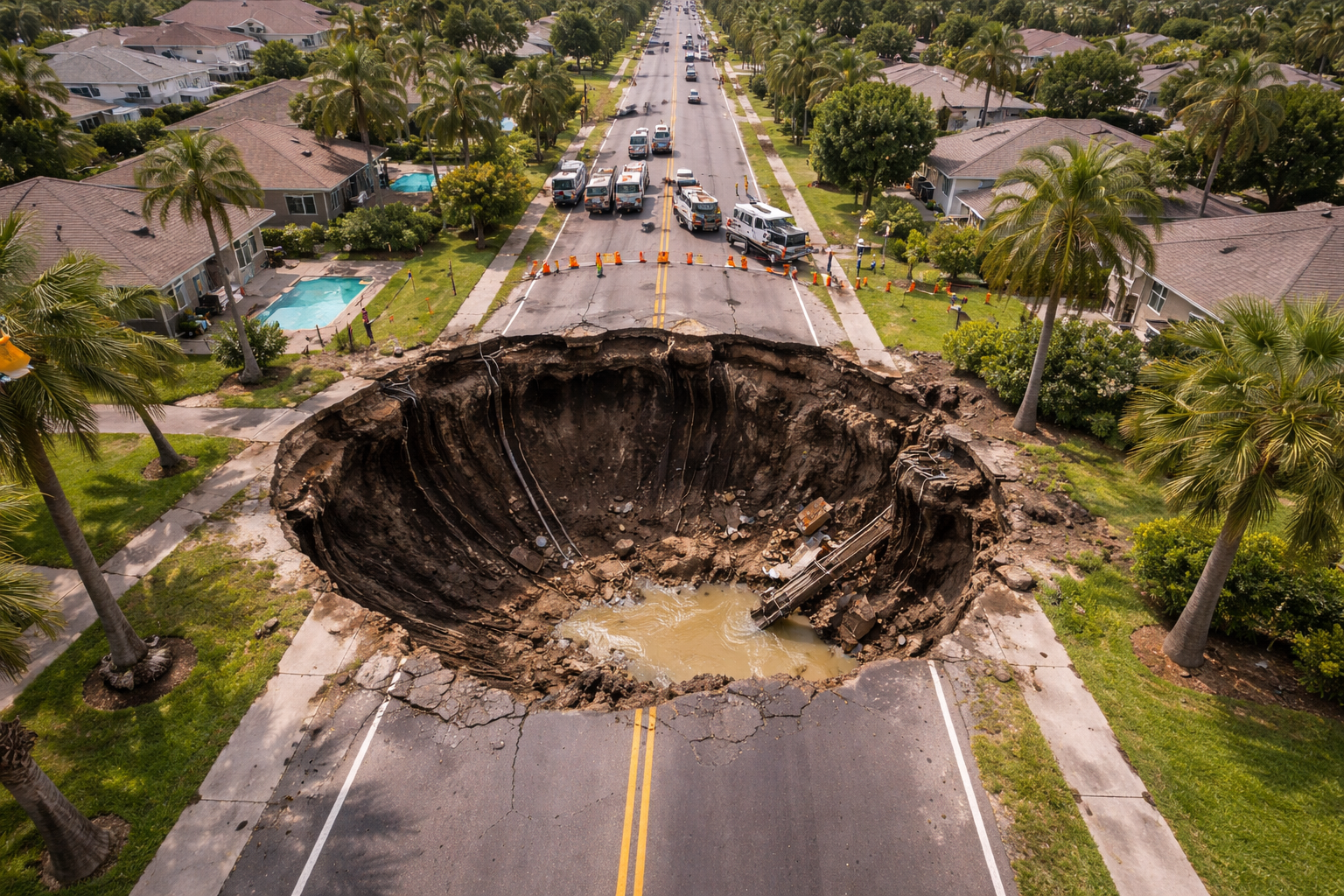
Sinkholes in Hillsborough County and Why District 1 Residents Must Pay Attention
In February 2013, a Seffner man went to sleep in his home and never woke up — swallowed by a sinkhole that opened silently beneath his bedroom floor. It was a jarring reminder that in Hillsborough County, the ground itself cannot always be trusted. For residents of District 1, this is not a distant threat. It is the geology underfoot, every single day.
Florida’s Hidden Architecture
To understand why sinkholes plague Hillsborough County, you have to look beneath the surface — literally. Florida sits atop a foundation of limestone and dolomite, the two most common carbonate rocks in the state. Karst is the term for the characteristic terrain produced by the chemical weathering and dissolution of these rocks.
Dissolution begins when limestone is exposed to acidic water. Most rainwater is slightly acidic and becomes more so as it percolates through decaying plant debris. Because limestone is porous, this acidic water seeps through its strata, dissolving the rock and carrying it away in solution. Over vast stretches of geologic time, this persistent erosional process has created extensive underground voids and drainage systems throughout much of the state.
A typical cross-section of the Tampa area’s geology reveals three distinct layers: Quaternary marine sands at the surface, a Miocene/Pliocene-aged confining clay unit known as the Hawthorne Group in the middle, and Eocene Ocala Limestone bedrock at the base. Sediment slowly ravels into void spaces in the limestone, creating a subdued sinkhole feature at the surface.
The Two Types of Sinkholes
Cover-Subsidence Sinkholes
These form gradually and quietly. As sand and sediment slowly filter downward into the voids below, the surface settles over time. Residents may notice a shallow depression forming in the yard or a gradual dip in their driveway — signs that material is being lost underground. These sinkholes are the most common in the county and, while less dramatic, can still cause serious structural damage to homes and infrastructure.
Cover-Collapse Sinkholes
These are the terrifying kind — the ones that make national news. When the surface cover collapses suddenly, it creates a cover-collapse depression. The soil arch holding up the surface fails in an instant, and everything above — a house, a car, a road — can plunge into the void below. The 2013 Seffner collapse, which claimed one life, was this type of event.
The Florida karst plain has one of the highest sinkhole depression densities in the world — roughly 7.94 sinkholes per square kilometer.
Why Hillsborough County — and District 1 — Are at Such High Risk
Most sinkholes in Florida appear in what geologists call “Sinkhole Alley” — Pasco, Hernando, and Hillsborough counties north of Tampa. The high water recharge and thin soils in this corridor speed up limestone dissolution. Urban growth, irrigation, and changes in water flow can trigger new sinkholes.
Research published in Engineering Geology mapped three distinct sinkhole clusters across the Tampa area. The first cluster is located within the northwestern area of the city — the Carrollwood area — which developed between the 1940s and the 1980s. There, the sinkholes are large and typically in the form of lakes, preserved through the development process and used as amenities for housing developments. The New Tampa sinkhole cluster is much wider, extending beyond the northern and western edges of the city into a broad undulating sinkhole landscape.
District 1, which encompasses much of the county’s northern and northwestern unincorporated communities — including areas bordering Carrollwood, northwest Tampa, and the New Tampa corridor — sits squarely within or adjacent to these high-density sinkhole clusters. The very neighborhoods where thousands of families live, commute, and send their children to school are underlain by the same porous limestone that has claimed homes and lives across the region.
Human activity compounds the natural risk. Sinkholes occurred in conjunction with the development of each of several well fields — Cosme (1930), Eldridge-Wilde (1954), Section 21 (1963), and South Pasco (1973). The effects of pumping on sinkhole development illustrate the general relationship between groundwater withdrawal and collapse events. When water is pumped from the aquifer system, it removes the pressure that was helping support underground cavities, making collapse far more likely.
Incidents That Hit Close to Home
2010 — University of South Florida Area, Tampa
A sinkhole swallowed a car and forced 11 families to evacuate a residential building — a stark reminder that dense urban neighborhoods are not immune.
2013 — Seffner: The Incident That Shocked the Nation
A cover-collapse sinkhole swallowed a man’s bedroom in the middle of the night. His body was never recovered. The repair required $350,000 and 92 cubic yards of grout to stabilize the ground.
2015 — Brandon: Road Collapse on State Road 674
A sinkhole caused a road collapse that took 11 days and 48 tons of fill material to repair, at a cost of $214,000. The disruption affected thousands of daily commuters.
2017 — Land O’ Lakes: Two Homes Destroyed
A massive sinkhole just north of Tampa swallowed two homes entirely and forced the evacuation of five neighboring properties — making headlines across the state.
2020 — Lithia: 22-Foot Deep Sinkhole
A sinkhole measuring 22 feet deep and 18 feet wide opened in a residential area, requiring $187,500 in specialized repair using piers and structural foam.
Warning Signs Every Resident Should Know
Sinkholes rarely strike without warning. Knowing what to look for can be the difference between an early — and manageable — intervention and a catastrophic collapse.
- Sticking Doors & Windows — Frames shift as the foundation moves. Doors or windows that suddenly jam or no longer close properly are an early structural warning sign.
- Cracks in Walls or Floors — Diagonal cracks running from corners of doorways or windows, or new cracks over ¼ inch wide in a foundation, warrant immediate professional evaluation.
- Circular Ground Depressions — A bowl-shaped or circular depression forming in your yard — especially one that appears suddenly or grows over time — is a key indicator of subsurface activity.
- Cloudy Well Water — Sudden cloudiness or sediment in well water can indicate that surface material is infiltrating the underground water system through a developing void.
- Tilting Trees or Fence Posts — When the ground shifts beneath them, vertical structures like fences, utility poles, or trees begin to lean without any external force.
- Sloping or Uneven Floors — If floors that were once level now feel like you’re walking uphill or downhill inside your home, the foundation may be settling unevenly.
⚠ Emergency Protocol: If the ground collapses near your home, or if you detect gas or water leaks associated with ground movement, call 911 immediately. For non-emergency sinkhole concerns, contact Hillsborough County Public Works at (813) 635-5400. The county maintains a 24/7 assessment team. If your foundation shifts more than one inch or you see new cracks exceeding three feet in length, evacuate and do not re-enter until cleared by a professional.
What Residents and Policymakers Can Do
The Hillsborough County Planning Commission uses a color-coded system with red and green markers to show sinkhole risk levels across the county. This data should be in every homebuyer’s checklist, and every District 1 resident deserves to know their property’s risk profile before problems arise.
At the policy level, several priorities deserve continued attention from county commissioners and local officials:
Aquifer management. Because groundwater withdrawal accelerates sinkhole formation, responsible management of pumping from the Floridan Aquifer system is a direct public safety issue — not just an environmental one. Decisions made by the Southwest Florida Water Management District have real consequences for residents in District 1.
Development review. Many older fossil sinkholes are destroyed in the development process. New construction in sinkhole-prone zones should require rigorous geotechnical analysis, with developers held accountable for adequately assessing and disclosing subsurface risks.
Infrastructure inspection. Roads, water mains, and utility lines that run through karst terrain need periodic geophysical inspection — technologies like Ground Penetrating Radar can identify developing voids before a road disappears.
Insurance literacy. By Florida law, every homeowner policy covers “catastrophic ground cover collapse,” but to cover slow-moving or cosmetic sinkhole damage, homeowners need a special endorsement. Many District 1 residents may not realize their standard policy leaves significant gaps.
The Ground Is Not Going to Change — But We Can Prepare
Hillsborough County will always sit atop its limestone foundation. The karst geology that makes sinkholes a fact of life here is millions of years in the making and cannot be undone. What can change is how seriously residents, builders, insurers, and county officials treat this risk.
For those living in District 1, awareness is the first layer of protection. Know your property’s history, recognize the warning signs, maintain adequate insurance coverage, and don’t hesitate to call a licensed geologist or engineer if something looks wrong. The ground beneath your feet has been quietly doing what it does for centuries — your job is simply to stay one step ahead of it.
Sources: Florida Department of Environmental Protection · Florida Geological Survey · USGS West-Central Florida Sinkhole Report · Engineering Geology, Brinkmann et al. (2008)
FDEP Sinkhole Resources | Report a Sinkhole to Hillsborough County